Ramsons (wild garlic)
Allium ursinum
Contents
Cultivation
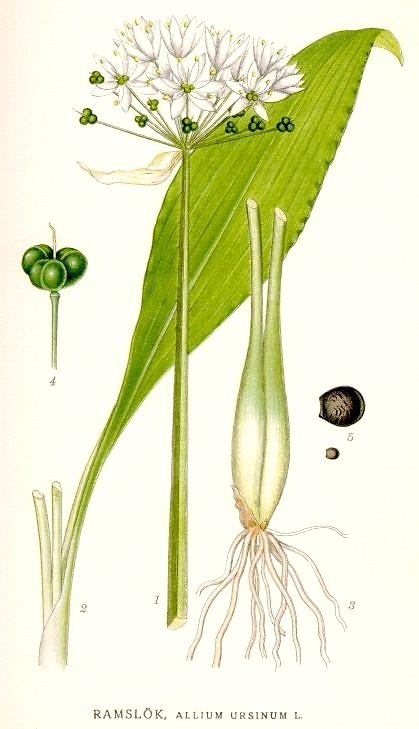
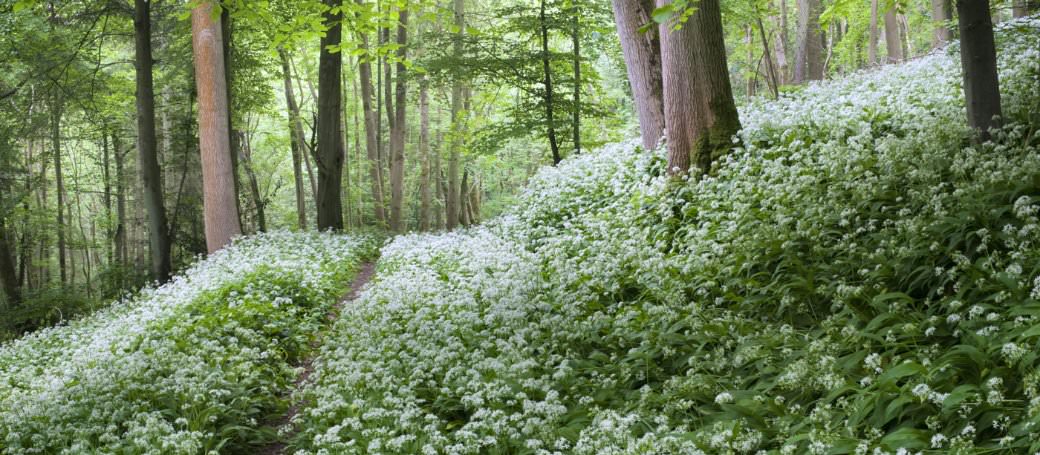
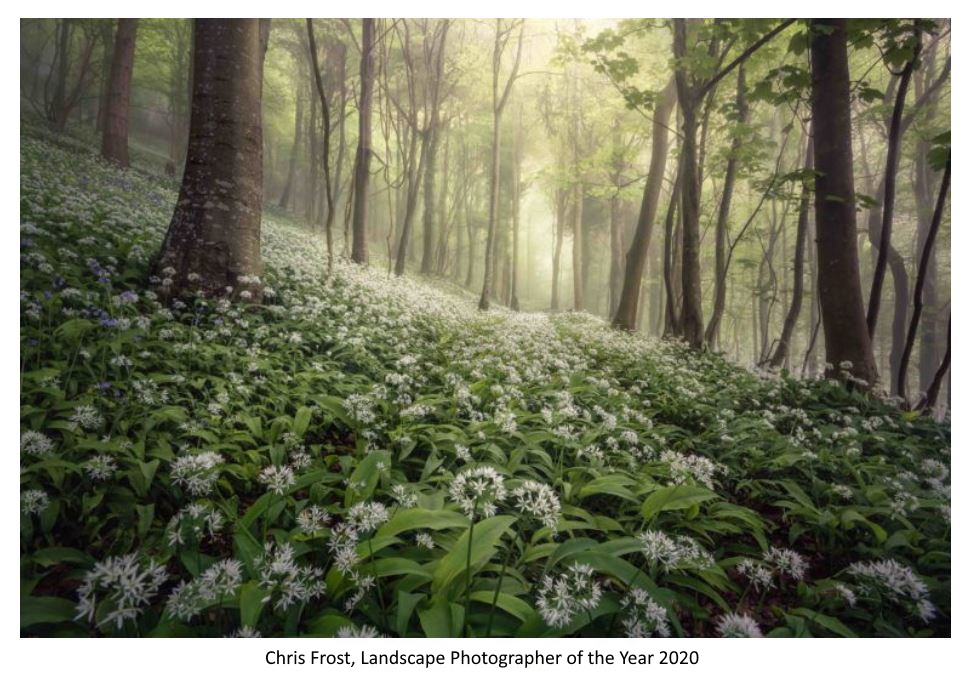
Wild garlic (ramsons, buckrams, broad-leaved garlic, wood garlic, bear leek, bear's garlic) grows abundantly throughout the UK, preferring semi-shade under deciduous trees. It will succeed in most soils and prefers moist conditions, though it will also succeed where the soil is very wet in the winter. When given suitable conditions, it will form a dense carpet of growth and can be very invasive. The plant comes into growth in the middle to late winter, flowers in the spring (before deciduous trees leaf) filling the air with their characteristic garlic-like scent and then dies down completely by the middle of summer. This allows many other plants that come into growth in spring to grow in the same space.
In the milder parts of England such as Cornwall, the leaves first show around St. Valentine's Day in week 7 (mid-February) and from St. David's Day in week 9 in less mild areas, dying back in July when the seeds ripen.
Once this plant is established in your garden, you are unlikely to be without it, or to need to propagate it. However, should you want to introduce it to a new site, either
- harvest the seed in early summer and sow it immediately in a shady site either in situ under deciduous foliage (preferably dark enough to inhibit grass growth) or in trays in a cold frame. It usually germinates well and should produce plants large enough for harvesting in the third year of growth when it first flowers; or
- dig up some bulbs in the summer, once the plants have died down, and plant them immediately into their new site. They will be ready for harvesting from their second year of growth.
Ramsons can become dominant on ideal sites and, although the plants are susceptible to drought and require moist soils, they are also intolerant of waterlogged conditions.
"Wild Garlic: How to forage it, and how to grow your own" Mark Diacono, Country Life, 12 February, 2023
If you are new to foraging, wild garlic is the ideal place to start says Mark Diacono.
As Spring pokes the tip of its nose out from under winter's blanket, my wife and I and our daughter take to coastal woods in search of damp, half shade and the magic that lies within.
We may not be the only ones: there are often others with basket, sharp knife and a hopeful gaze after 'their' patch of wild garlic (Allium ursinum, also known as ramsons). This annual pilgrimage carries much significance now: as well as being one of the few forages we have long done as a family, it soaks us all in optimism that perhaps winter really is soon to be behind us.
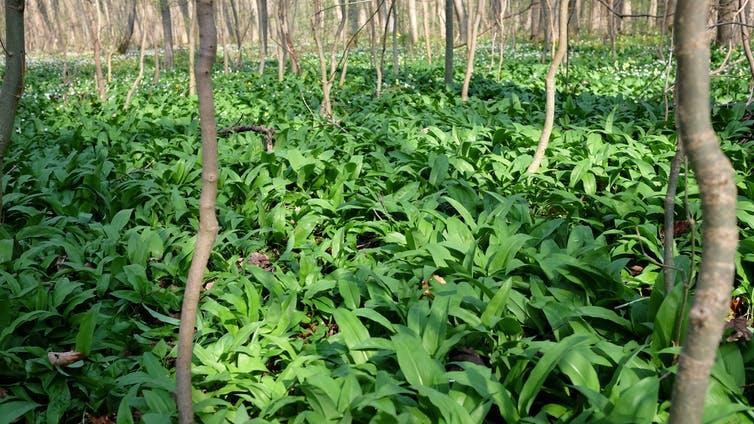
If you are new to and, perhaps, a little nervous of foraging, wild garlic is a good place to start. Its wide green tongues are easy to identify; although a few plants (including lily of the valley) look superficially similar, none has its characteristic bright garlic scent. The bulbs, buds and flowers are all edible, but it is the young leaves that are the primary harvest.
Rather than pulling up the plant, slicing through the leaves an inch or so above ground allows the plant to persist and new leaves to grow; it only takes us 15 minutes at most to cut a basketful. We take care to pick from a patch a few steps from the path to avoid dog pee, but, when home, I always soak the leaves in the sink for a quarter of an hour or so to dislodge rogue leaves and other woodland detritus. As with salad leaves and lettuces, this also conditions them, extending their shelf life. Drained, dried and bagged, wild garlic will last at least a week in the bottom of the fridge.
The leaves lose much of their bright, fresh flavour if overcooked: a handful briefly wilted into scrambled eggs provides the reward once we are back indoors, with pesto making and wild-garlic ravioli likely to follow. I freeze a few handfuls, briefly blanched, to use another time. You may find buds and/or white flowers in the harvest: both are very good in tempura or for adding a little punch and contrast in leafy salads.
Wild garlic will also thrive in your garden. There are few plants that do so well in damp shade, especially providing delicious ground cover, too, but wild garlic will grow well in sunnier spots and in a well-drained soil, although avoid anywhere too dry. Bear in mind that the shadier the spot, the longer the harvest season, often stretching into early summer, and that once summer's heat crosses an invisible threshold, the leaves vanish back to the bulb, reappearing in the new year.
Wild garlic is easy to grow from seed or young plants. I am usually in favour of shortening the journey from planting to eating, so, in my own garden and when designing and planting others, I almost always start with young plants. For those with more patience, sow seeds undercover in March, keep the compost lightly moist and germination should occur one to two weeks later. Transplant to their final location four weeks later allowing 4in between plants. You can sow them direct in May. Allow plants to go unharvested for the first year to get established, removing the flower spikes as they appear to direct the plant's energies to developing well.
Once growing, wild garlic will reach 16in - 20in high and give you several cuts in the heart of the season, from March to the end of May, with a week or two either side, depending on location and weather. It forms dense colonies over time by multiplying its underground bulbs. It can spread at a reasonable rate in the encouraging conditions of a beech woo and, although this happens at a much slower pace - if at all - in your garden, you can always lift and remove any bulbs threatening to spread into unwanted territory.
You may wonder why you should bother growing wild garlic when it can be so abundant in the wild. Firstly, as much as I enjoy foraging, having a little on your doorstep to use at short notice is so good; secondly, many parts of the country (for example, the dry South-East) have little wild garlic growing naturally; and thirdly, it can be the perfect answer if you are looking to colonise a shady, damp spot with something delicious and perennial — and that attracts pollinators and other beneficial insects.
Mark Diacono grows edibles, both usual and unusual, at Otter Farm in Devon . His latest book is 'From Scratch: Ferment' (Quadrille, £12.99)
Identification
"The Wild Flower Key" (2006) Francis Rose & Clare O'Reilly at page 515
Lily Family
Ramsons, Allium ursinum (Ancient Wood Indicator), perennial herb to 45 cm; 2-3 leaves, elliptical-oval, 10-25 cm (long) x 4-7 cm (wide), bright green, pointed, on long stalk twisted through 180°; stem 10-45 cm tall, weakly three-angled; spathe of 2 papery bracts shorter than flowers; umbel 6-20 flowered, ± flat-topped, bulbils absent; perianth segments white, 8-10 mm long, lanceolate; stamens with short narrow stalks. British Isles, common (except NE Scotland, Ireland, frequent); in moist woodlands, hedgebanks, especially on calcareous or richer soils. Flowers 4-6.
In England, an 'ancient woodland' is a woodland that has existed continuously since 1600. Before that date, planting of new woodland was uncommon, so a wood present in 1600 was likely to have developed naturally.
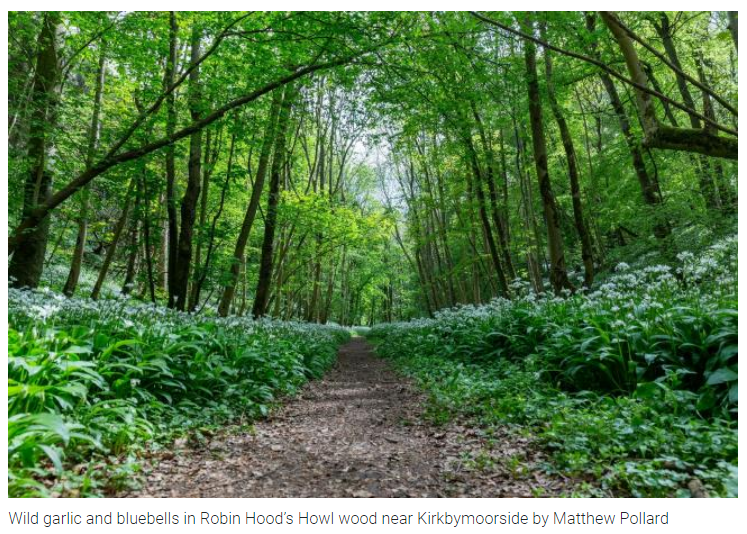
The ramsons stem is weakly three-angled in cross section, twisted through 180° with a midrib weakly raised below. The leaves are similar to that of the lily-of-the-valley (Convallaria majalis). Unlike the related Allium vineale (crow garlic) and Allium oleraceum (field garlic), the flower-head contains no bulbils, only flowers. In the British Isles, colonies are frequently associated with bluebells (Hyacinthoides non-scripta), especially in ancient woodland. Allium ursinum is an indicator species for ancient woodlands in North Yorkshire categorised as "wet" and "neutral to calcareous".
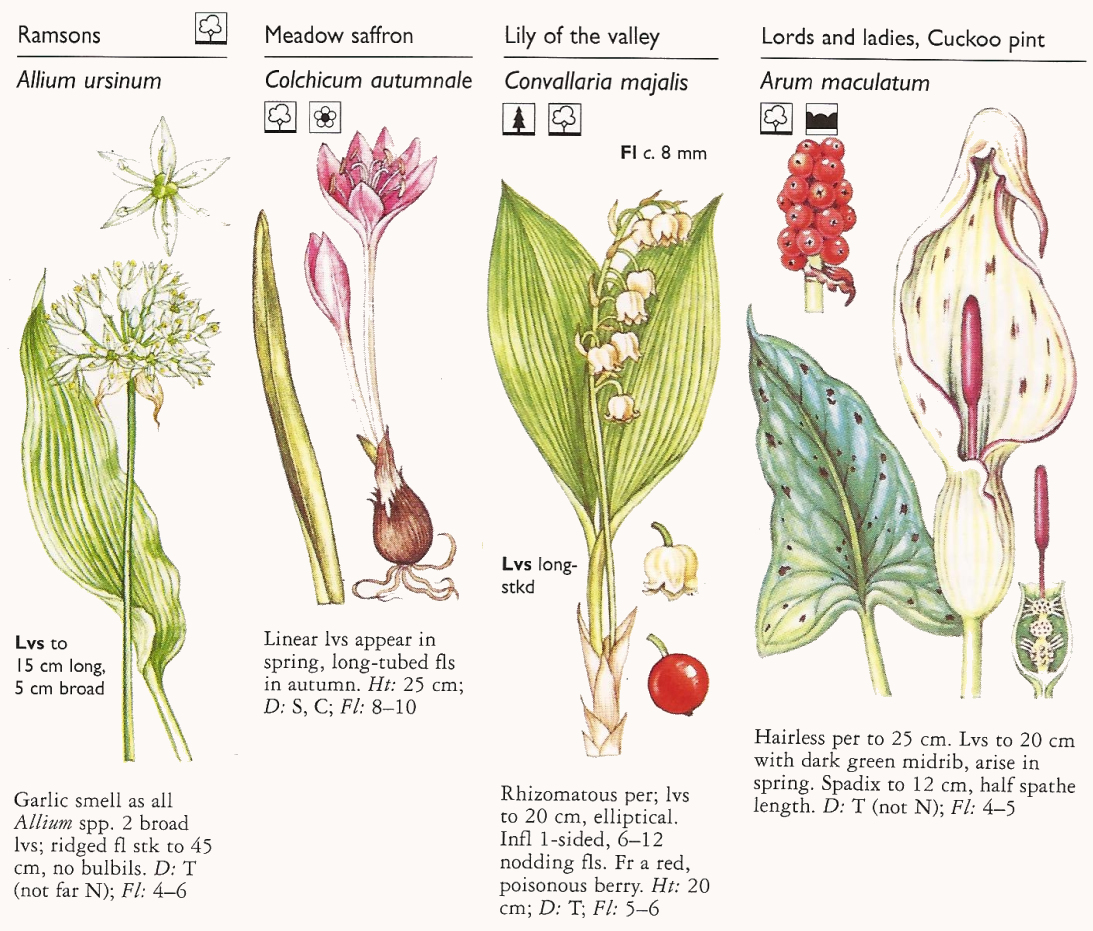
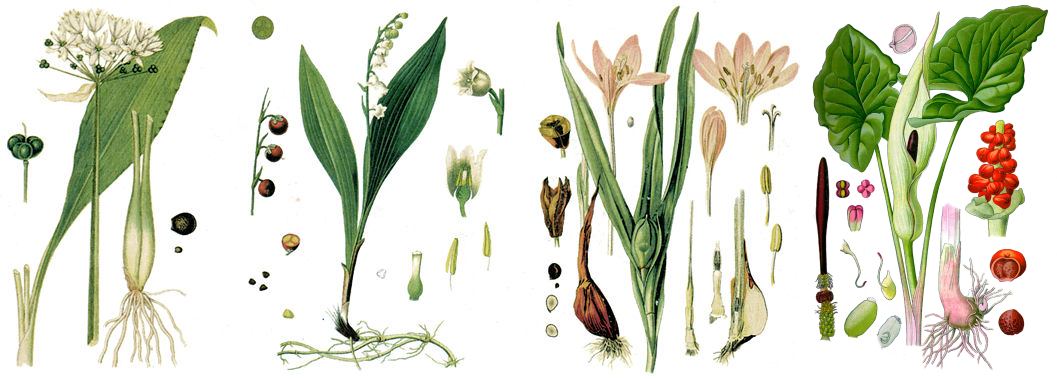
The leaves of Allium ursinum are easily mistaken for:
- meadow saffron (Colchicum autumnale)
- lily-of-the-valley (Convallaria majalis)
- lords-and-ladies (Arum maculatum) and
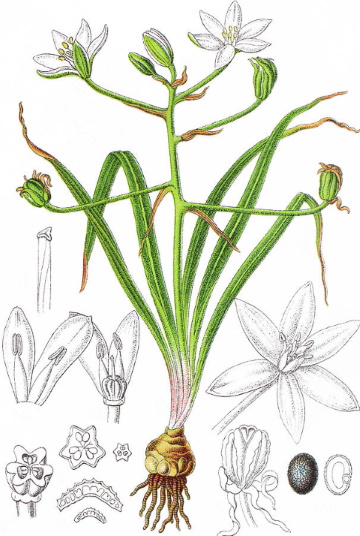
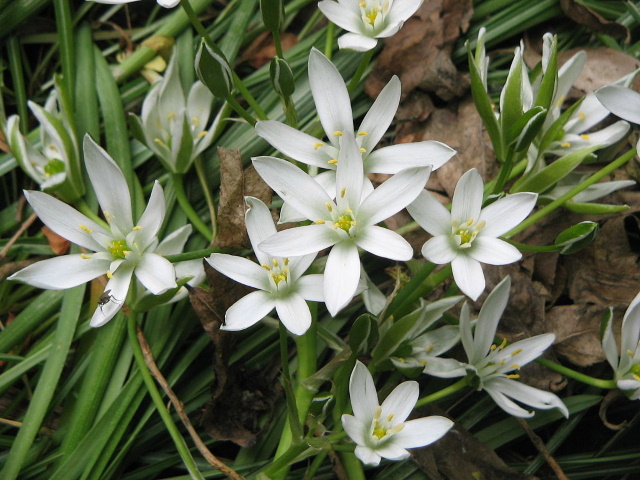
- star-of-Bethlehem (Ornithogalum umbellatum)
all four of which are poisonous and potentially deadly incidents occur almost every year.
Star-of-Bethlehem Ornithogalum umbellatumColchicum plants have been mistaken by foragers for ramsons, which they vaguely resemble, but are deadly poisonous due to their colchicine content. The symptoms of colchicine poisoning resemble those of arsenic, and no antidote is known. Lily-of-the-valley is highly poisonous - all parts of the plant contain cardiac glycosides, as well as saponins, and the mechanism of poisoning works in a similar way to foxglove (Digitalis purpurea). Star-of-Bethlehem (Ornithogalum umbellatum) - sometimes seen as a garden escape - contains cardiac glycosides, especially the bulb and flowers, specifically convallatoxin and convalloside which are toxic to humans, pets and livestock.
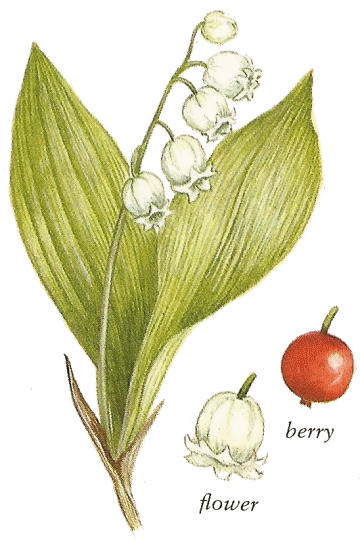
Most cases of poisoning from lily-of-the-valley are due to people, particularly children, eating the bright red berries the plant produces later in the year. Vomiting usually limits the absorption of the toxins but in extreme cases ingestion can cause coma or death. There are also cases of poisoning from the leaves of lily-of-the-valley being mistaken for the leaves of ramsons and added to soups or fried with other ingredients. Signs and symptoms included flushed skin, nausea, dizziness, headache, weakness, hallucinations and changes in heart rate.
In the British Isles lily-of-the-valley typically flowers in May and June, while ramsons bloom in April and May. In other parts of Europe lily-of-the-valley is particularly associated with the month of May. Indeed, majalis means "of or belonging to May".
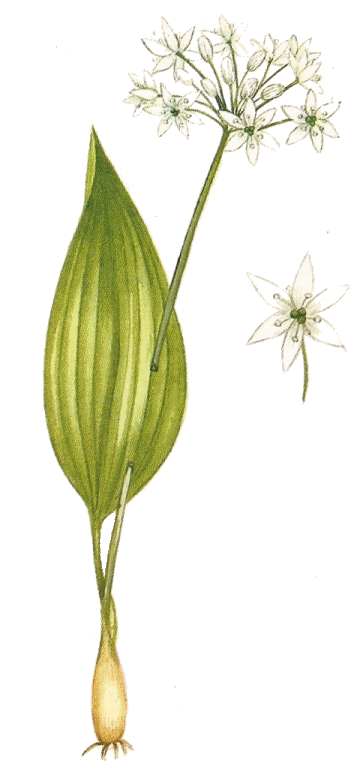
When either ramsons or lily-of-the-valley are in flower, it is simple to tell the plants apart. While the flowers of both plants are white, they are easy to distinguish. Ramsons have a clustered globe of white flowers at the end of an upright stem, while lily-of-the-valley has drooping bell-shaped flowers arranged along a stem. It's only when both plants have leaves present - but neither have flowers - that the two look similar. The three main differences are:
- the leaves of ramsons emanate singly at the base of the plant, while lily-of-the-valley has two (or three) leaves on the same stem;
- on close inspection, the structure of the leaves is different;
- the most obvious difference is that the leaves of ramsons smell strongly of garlic whilst the leaves of lily-of-the-valley do not smell of garlic.
Grinding the leaves between the fingers and checking for a garlic-like smell can be helpful, but if the smell remains on the hands, one can easily mistake a subsequent poisonous plant for wild garlic.
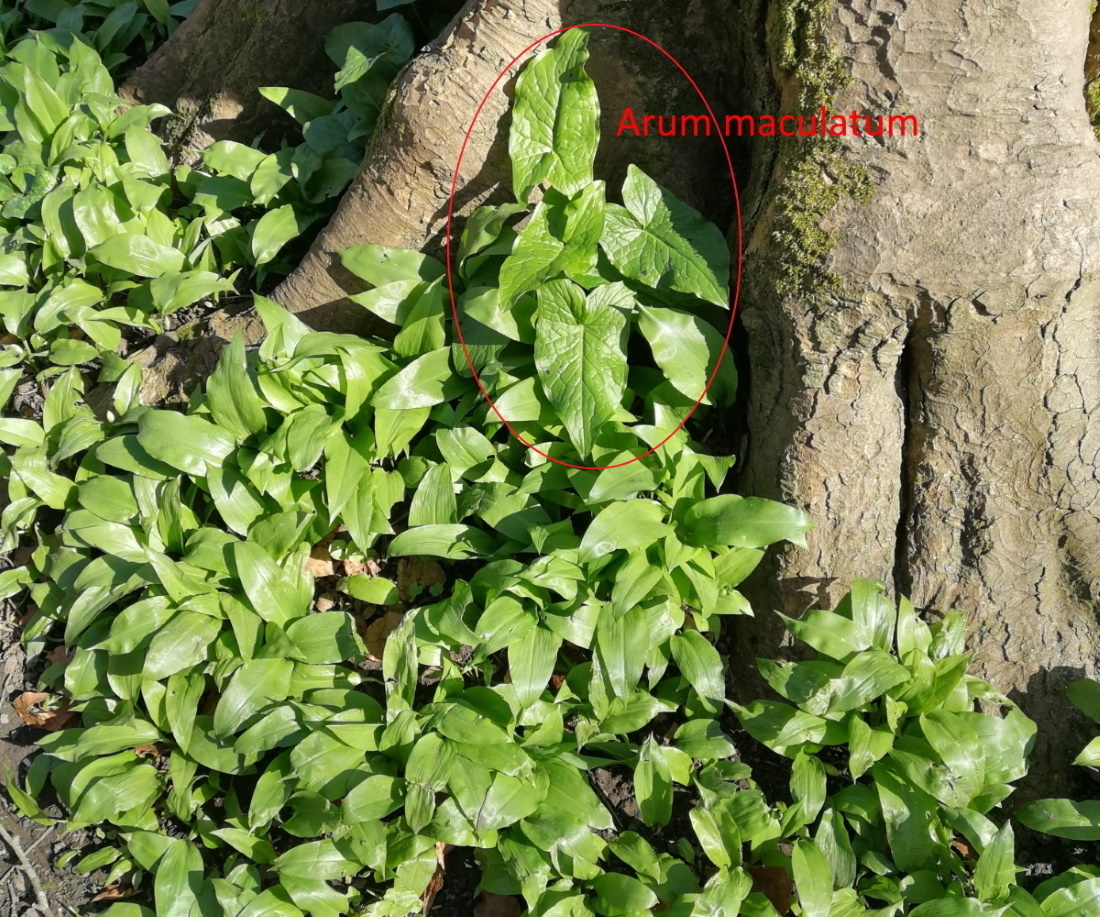
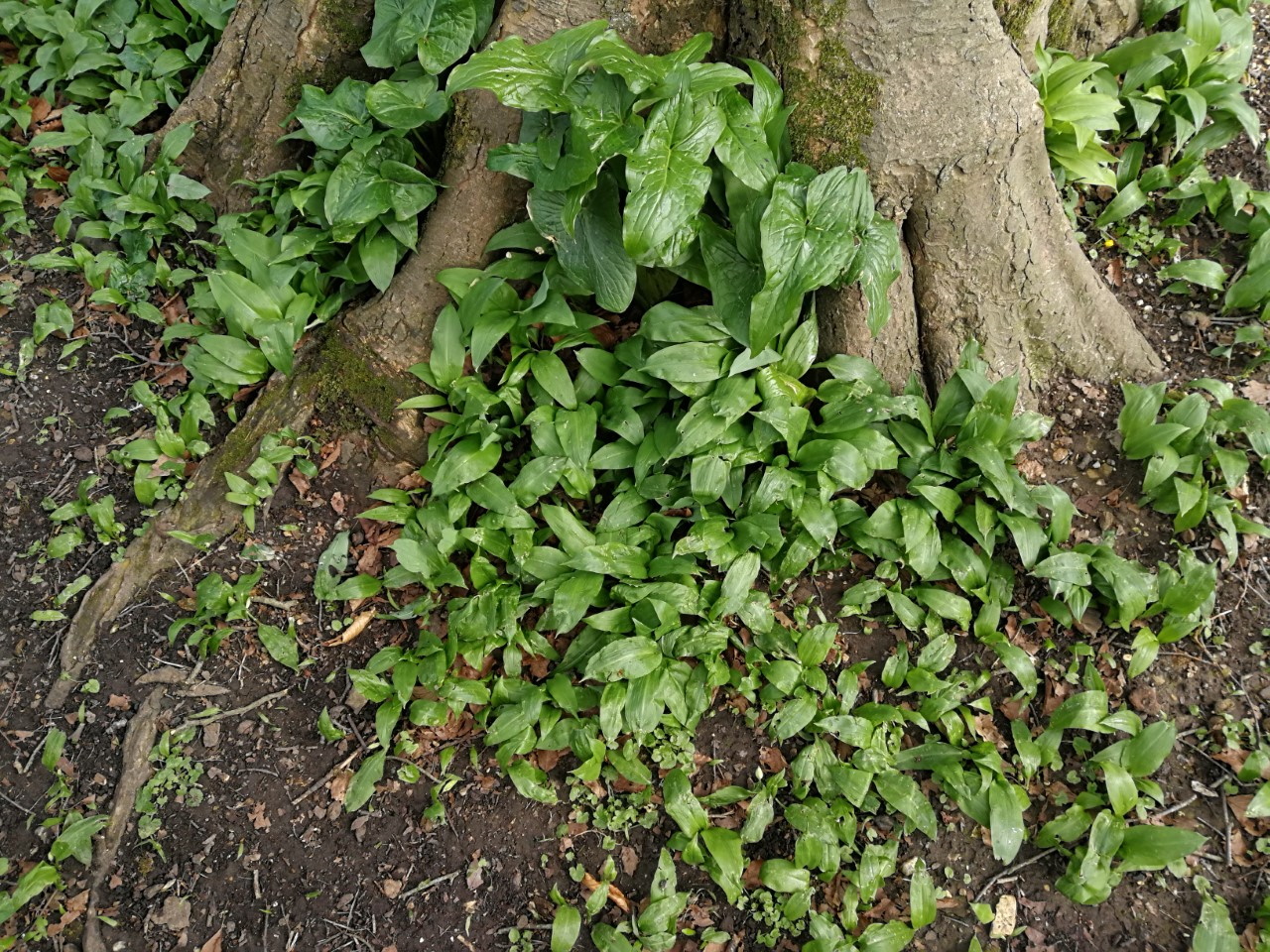
When the leaves of ramsons and lords-and-ladies first sprout they look similar, but unfolded lords-and-ladies leaves have irregular edges and many deep veins while ramsons leaves are convex with a single main vein. The leaves of lily-of-the-valley come from a single purple stem, while the leaves of ramsons have individual green-coloured stems.
Regular handling of lily-of-the-valley can cause dermatitis, so wash your hands thoroughly if you crush their leaves for the purpose of smelling them.
The potential for confusing ramsons with lily-of-the-valley is usefully demonstrated in the way they are "keyed out" by John Kilbracken's dichotomous key:
"The Easy Way to Wild Flower Recognition" (1984) John Kilbracken
How to Use this book
This book has been written with only one end in view - to help the beginner to identify, more easily than ever before, the wild flowers most likely to be seen in Britain and Ireland. It does this in a way that is quite different from all the other flower identification books available. With the other books, unless you know the family to which the flower you have seen belongs, you must go through the whole volume looking at the illustrations and reading often complex descriptions until you decide which is the right one.
In The Easy Way to Wild Flower Recognition, you are led through the book by a number of simple questions about the flower you are identifying, till you quickly arrive at the answer … If you glance at the text, you will see that it consists of a series of Questions and Answers, numbered consecutively from 1 to 373. The Questions are numbered in blue, the Answers in yellow. When you wish to identify a flower, always start at Question 1. Have a look at it now: it asks you what colour the flower is. You should have little trouble in deciding on the correct reply, which directs you to the next Question. So you are led on, rather as though you were following the clues in a treasure hunt, towards identification. The Questions are extremely simply worded, and there is nearly always a passage of text and illustrations to help you choose your answer. All technical terms you might not know or understand have been avoided; or, if this sometimes proved impossible, they are carefully explained.
After perhaps as few as three Questions, and never more than a dozen, you'll find that you arrive at an Answer. Here the flower is illustrated in colour, with a passage of descriptive text giving details that will help in identification. The months when the flower is most likely to be in bloom are also given. In almost every case, each species has an Answer to itself, and your trail is at an end. Occasionally, where two species are very similar, they are taken together in the same Answer. Both species are illustrated, so you should have no trouble deciding between them.
Now let's see how the book works in practice …
- [1] What colour are its flowers?
In most cases the answer will be self-evident. If two or more colours are present, choose the one that is most noticeable. It is only with purplish flowers that you may feel any doubt. Make it the rule to choose 'Red or reddish' if they are pink, purple-red, or any other colour that seems on balance closer to red than blue. Choose 'Blue or bluish' if they are violet, lilac, purple-blue, or any other colour that seems closer to blue than red.
Yellow [2]
White or greenish-white [87]
Red or reddish [192]
Blue or bluish [292]
Green or brown [342]- [87] (from 1) Is the plant growing in water?
Answer 'Yes' if the lower part of the stem, or all of the stem, is submerged in water. Answer 'No' if the plant is growing on dry land, or if only the roots are submerged.
Yes [88]
No [93]- [93] (from 87) How do the leaves grow?
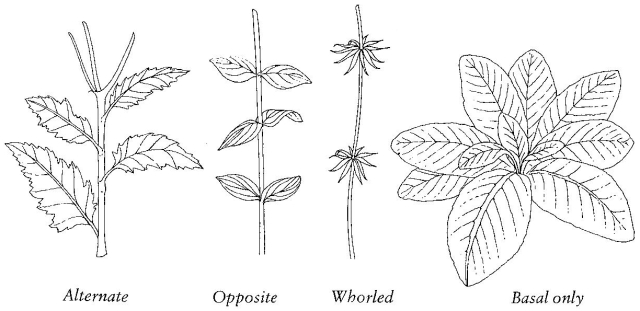
Leaves are described as being alternate, opposite, whorled or basal, depending on how they grow along their stem or stalk. Alternate leaves grow singly, on alternating sides of the stem. Opposite leaves are in pairs, and whorled leaves in groups of 3 or more around it. Choose 'Basal only' if all the leaves grow at the very base of the plant. The drawings should make your choice quite easy.
Alternate [94]
Opposite or whorled [141]
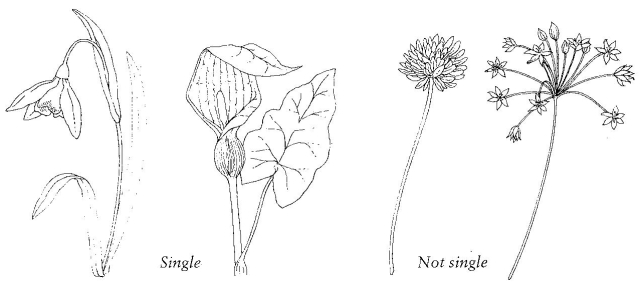
Basal only [171]- [171] (from 93) Do the flowers grow singly?
Answer 'Yes' if each flower is solitary, with its own stalk or stem to itself. Answer 'No' if several or many flowers grow close together; the flower-stalks, if any, are very short. (Note: the well-known clovers may at first appear to have flowers growing singly, but in fact each flowerhead is composed of many tiny flowers and you should answer 'No'.)
Yes [172]
No [184]- [184] (from 171) Does it have rounded flowerheads?
Answer 'Yes' if the plant is a clover, with many very small flowers growing close together in a rounded flowerhead. Otherwise answer 'No'.
Yes [185]
No [186]- [186] (from 184) Are the leaves sticky?
Answer 'Yes' if the leaves are fringed with long red sticky glands. Otherwise answer 'No'.
Yes [187]
No [188]- [188] (from 186) Are the leaves toothed?
Answer 'Yes' if the leaves are toothed all round their margin. Answer 'No' if they are quite smooth.
Yes [290]
No [189]- [189] (from 188) Are the flowers sweet-smelling?
Answer 'Yes' if they are noticeably sweet-scented. Answer 'No' if the whole plant smells strongly of garlic.
Yes [190]
No [191]- [190] (from 189) Lily-of-the-Valley (Convallaria majalis)
This plant is more often cultivated in gardens, but also grows truly wild in dry woodland. Each stem bears a long cluster of 6-12 pure white, drooping, bell-shaped flowers, all facing the same way. The pointed leaves, which are stalked and hairless, grow in pairs at the base of each stem. Flowers May-June.- [191] (from 189) Ramsons (Allium ursinum)
The star-like, pure white flowers grow singly on short radiating stalks at the end of each stem. The broad, pointed leaves are on individual stalks, arising from the base of the plant, which has a strong smell of garlic. It grows in woods and hedgerows. Flowers April-June.
Lily-of-the-Valley (Convallaria majalis) Ramsons (Allium ursinum) John Kilbracken's dichotomous key has brought us through eight (8) character couplets of contrasting leads to a simple yes/no choice based on smell - [190] is lily-of-the-valley and [191] is ramsons - demonstrating how these two plants closely resemble each other in virtually all characteristics save smell, notwithstanding that the flowers are quite different in form and structure. Reference is made in character couplet [189] to the 'sweet-smelling/sweet-scented' flowers of lily-of-the-valley, but no further reference thereto is made in that plant's more detailed description in [190].
"The Scented Wild Flowers of Britain" (1971) Roy Genders at pages 205, 206 and 214
… LILY OF THE VALLEY Convallaria majalis … The white bell-shaped flowers are borne 6-12 in a 6-in, tall 1-sided raceme and are deliciously scented. They are followed by globose red berries … it is one of the loveliest of all our native flowers with a spicy scent, like that of the Dame's Violet which draws the night hawkmoths from a distance … In the Profitable Art of Gardening (1568), Thomas Hyll wrote of "the Wood Lily or Lilly of the Valley (which) is a flour marvellous sweete … Henry Lyte in his New Herbal (1578) calls it the Lilly Convall and describes the flowers as being "as white as snow and of a pleasant strong savour." … In The Flower Garden (1726) John Lawrence described the scent of the Conval-lily as the sweetest of all, neither offensive nor over-bearing … "Sweet May Lillies richest odours shed, Down the valley's shady bed" wrote Sir Walter Scott … Keats said of them: "No flower amid the garden fairer grows, Than the sweet lily of the lowly vale, The Queen of Flowers." … Specially retarded crowns (roots) are available from nurserymen in Germany for forcing in gentle heat in pots, to be taken indoors for winter flowering when their fragrance is always appreciated … There is a double form, flore plena, and another bearing pink flowers, rosea, but neither is as lovely as the single white form with its highly scented flowers … Hartley Coleridge, contemporary of Shelley [6], considered the Lily of the Valley to be the loveliest of all scented flowers. His lines dedicated to the flower are among the most beautiful in our language:
The Lily of the Valley (24th May 1846)
Some flowers there are that rear their heads on high,
The gorgeous products of a burning sky,
That rush upon the eye with garish bloom,
And make the senses drunk with high perfume.
Not such art thou, sweet Lily of the Vale!
So lovely, small, and delicately pale,
We might believe, if such fond faith were ours,
As sees humanity in trees and flowers,
That thou wert once a maiden, meek and good,
That pined away beneath her native wood
For every fear of her own loveliness,
And died of love she never would confess.This poem is included in New Poems published by the OUP in 1942 which volume is dedicated to Edmund Blunden - see Hooge.
… RAMSONS Allium ursinum … A broad-leaved species, the bright green leaves resembling Lily of the Valley but releasing an obnoxious fetid smell of stale garlic. This is released with the slightest movement, for example a gentle breeze, so that quite a small colony may be detected from a distance. The flowers are white and are produced in a flat inflorescence on a 3-angled stem 12-14 in. tall. In bloom April-June … To countrymen it is known as the Broad-leaf Garlic, though its botanical name is taken from the similarity of its leaves to a bear's ear. The whole plant (including the root) gives off a fetid sulphurous smell. The leaves are used in the West Country to flavour pilchards and winter stews.
[6] "Flowers in Britain" (1944) L. J. F. Brimble at page 318: The white flowers appear in the wild state during May and June. They are borne about six to twelve in a drooping raceme which frequently hides beneath the canopy of leaves:
And the Naiad-like lily of the vale,
Whom youth makes so fair and passion so pale,
That the light of its tremulous bells is seen,
Through their pavilions of tender green;
The Sensitive Plant: Percy Bysshe ShelleyThere is less potential for confusing ramsons with lords-and-ladies (friar's cowl, adder's root, cuckoo pint, wild arum) as is demonstrated in the way lords-and-ladies is "keyed out" by John Kilbracken's dichotomous key:
"The Easy Way to Wild Flower Recognition" (1984) John Kilbracken
- [1] What colour are its flowers?
In most cases the answer will be self-evident. If two or more colours are present, choose the one that is most noticeable. It is only with purplish flowers that you may feel any doubt. Make it the rule to choose 'Red or reddish' if they are pink, purple-red, or any other colour that seems on balance closer to red than blue. Choose 'Blue or bluish' if they are violet, lilac, purple-blue, or any other colour that seems closer to blue than red.
Yellow [2]
White or greenish-white [87]
Red or reddish [192]
Blue or bluish [292]
Green or brown [342]- [87] (from 1) Is the plant growing in water?
Answer 'Yes' if the lower part of the stem, or all of the stem, is submerged in water. Answer 'No' if the plant is growing on dry land, or if only the roots are submerged.
Yes [88]
No [93]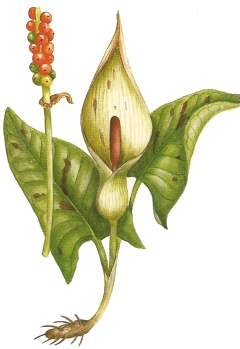
- [93] (from 87) How do the leaves grow?
Leaves are described as being alternate, opposite, whorled or basal, depending on how they grow along their stem or stalk. Alternate leaves grow singly, on alternating sides of the stem. Opposite leaves are in pairs, and whorled leaves in groups of 3 or more around it. Choose 'Basal only' if all the leaves grow at the very base of the plant. The drawings should make your choice quite easy.
Alternate [94]
Opposite or whorled [141]
Basal only [171]- [171] (from 93) Do the flowers grow singly?
Answer 'Yes' if each flower is solitary, with its own stalk or stem to itself. Answer 'No' if several or many flowers grow close together; the flower-stalks, if any, are very short. (Note: the well-known clovers may at first appear to have flowers growing singly, but in fact each flowerhead is composed of many tiny flowers and you should answer 'No'.)
Yes [172]
No [184]- [172] (from 171) Are the flowers regular ?
Answer 'Yes' if all the petals of each flower are equal in size and the same shape. Otherwise answer 'No'.
Yes [173]
No [183]- [183] (from 172) Lords-and-Ladies (Arum maculatum)
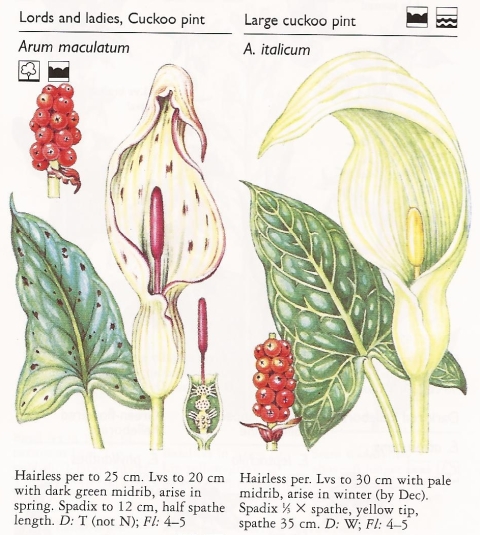
This plant is immediately recognizable because of its extremely unusual flowerhead. The true flowers are very small and hidden at the base of the poker-like flower spike, surrounded by the conspicuous, greenish-white flower-hood, which is erect, pointed and 15-25 cm in length. The shiny, hairless leaves grow on long stalks from the base. Lords-and-ladies, also known as cuckoo pint [1], grows in woods and hedgerows. Flowers April - May.[1] Editor's note: in 'cuckoo pint' the 'i' in 'pint' is pronounced as in 'mint' because it is derived from the Old English cuccopintle meaning 'cuckoo's penis' which it apparently resembles.
John Kilbracken's dichotomous key has brought us through six (6) character couplets of contrasting leads, only the first four (4) of which are common to ramsons, lily-of-the-valley and lords-and-ladies, diverging in response to the question "Do the flowers grow singly?" demonstrating that, although the leaves of these three plants may appear to be similar, in virtually all other characteristics they are quite different in form, smell and structure. Unfortunately, the author's key does not include meadow saffron.
It should be noted that, as with most floras, the author's dichotomous key can only be used during anthesis (i.e. the flowering period - see step 1) as is also the case with such floras as:
- "A Simple Field Key to Common British Wild Flowers" (1983) Sylvia M. Arnold, and
- "A New Key to Wild Flowers" (1995) John Hayward & Michael Hickey.
When in the field in the months before anthesis or following perianthic abscission i.e. July to March (the nine months of summer, autumn and winter), when ramsons, lily-of-the-valley and lords-and-ladies are unlikely to be in flower, refer to the following vegetative keys for accurate identification:
- "The Wild Flower Key" (2006, and first published in 1981) Francis Rose & Clare O'Reilly at pages 47 to 95 (the vegetative keys to plants not in flower) which 48 pages were published separately by Frederick Warne in 1983 as "The Vegetative Key to Wild Flowers", or
- "The Vegetative Key to the British Flora" (2009) J. Poland & E. J. Clement, which key enables the user to easily identify, with nothing more than a hand lens, any native or alien plant in the absence of flowers or fruit by its vegetative characteristics (primarily leaf structure, arrangement, margin, position, insertion, shape, cross-section, venation, tip, base and surface): "The idea has been for any diligent novice to identify a plant within three turns of a page, often identified correctly in under 30 seconds due to the simple polychotomous keys."
In his introduction to the "The Vegetative Key to Wild Flowers" at page three (3) Francis Rose explains the 'purpose and use of these keys' and 'coverage':
INTRODUCTION
Purpose and use of these keys
These keys are designed to enable their user to identify at least the commoner and more widespread plants, at times when no flowers are available for practice of the more usual form of plant identification, by flower structure. Except for the admirable key "British Water Plants", by S.M. Haslam, C.A. Sinker and P.A. Wolseley, Field Studies, vol 4 (1975), there seem to be no vegetative keys available in this country for the majority of flowering herbs (as opposed to trees and shrubs, or grasses). The keys will be useful not only to the amateur who wishes to know the name of a plant that he or she finds without flowers, but more specifically to the professional ecologist, or to the student doing a field project who has perforce to work in a particular habitat and at a season when few, if any, of the plants are in flower. The plants are grouped by habitats rather than by families because it is in their habitats that they are naturally grouped in the countryside. Some of the keys, particularly those to woodlands (I), chalk grasslands (H) and heaths (RI), will be useful even in winter, as many plants of these habitats remain visible above ground at that time. Other keys will be more useful from spring to autumn, at times when, although some species are in flower, many others are only in leaf. Because some aquatic plants are shy flowering, the flowers of many others inconspicuous and their structure difficult to interpret, the key to aquatic plants (IV) should be useful throughout summer and early autumn (many water plants are not visible in winter and spring).
Coverage
It was not practicable to include in these keys every species that might be found in the various habitats, and in some cases (particularly waste ground, roadsides, etc) the number of possible occurrences is almost unlimited. Also excluded are those annual weeds of cultivated ground that normally have flowers present (except as very young plants, when identification is in any case almost impossible) almost all the time they are above ground, Such plants (unlikely anyway to be seen in winter and early spring) are best identified by use of The Wild Flower Key. Critical (difficult), rare, or garden plants have also been omitted. In some cases firm identification beyond genus to distinct species cannot be achieved without flowers; with these the user is taken as far as possible, with an indication of further likely separation. However, many plants of grazed grassland, where animals have eaten all the flowers, should be identifiable with these keys. More detailed tips on the vegetative differences between plants in flower that look much alike are also given in "The Wild Flower Key".
The keys work on the so-called 'dichotomous' principle, in which at every step the reader is directed to a fresh set of clearly contrasted choices. In these keys, however, although in most cases the usual two choices are presented, there are sometimes three, four or even more, on occasions when the distinctions are sufficiently clear.
It is important to find the best leaves, shoots or fruits of each plant studied - tattered or broken leaves may be misleading. In many steps in the keys more than one character is given, in order to make identification more certain. Plants are very variable (it is man, not nature, that categorizes them), and sometimes two out of three (or three out of four) characters suggest one genus or species, but a fourth (or fifth) character another. In such cases the 'majority verdict' is to be preferred, and it must be accepted that identification must sometimes by tentative rather than conclusive.
At page seven (7) of his introduction to the "The Vegetative Key to Wild Flowers" Francis Rose describes the habitat in which these four (4) woodland herbs can be found:
INTRODUCTION
I Plants of Woodlands, Shady Hedgebanks and Sunken Lanes
Woodland of some kind is the natural ('stable' and 'climax') vegetation of most of Western Europe below the tree line on mountains, so very many of our native plants are forest species. Woodlands vary in flora according to the type of geological parent rock and hence of soil, according to the degree of drainage, and, of course, according to the type of human management exercised over the centuries. Today, much forest is composed of planted evergreen conifers; such woodlands, unless of some age and partially thinned out, are of very little botanical interest except along the open rides or paths where more light penetrates. Deciduous woodlands, formerly often managed by coppicing (cutting the shrub layer every 8-15 years), more closely reproduce the light and shade conditions of primeval forests, and tend to have retained a continuity of flora from prehistoric times. Coppicing, when practised, lets in the light, and the plants respond by a burst of flowering one or two years later. But many old coppices have now not been cut for years, this form of management being no longer considered economic, and in such woods many plants do not flower at all. In less dense woodlands, with a less closed shrub layer and tall mature trees (and hence woodlands of a more natural structure) there is a 'light phase' in spring when most plants tend to flower before the leaves of the trees unfold and reduce the light, but when it is nevertheless warm and sunny enough for herb growth. In many such woods comparatively few plants are still in flower during mid to late summer, but many woodland herbs, most of them perennials, remain growing and visible as leaf-rosettes, leafy runners or non-flowering shoots, in the autumn and even throughout milder winters. Most of the commoner of these species can thus be identified with this key throughout much of the year.
Woodland soil variations greatly affect the flora. On heavy clay soils waterlogging is common in winter, and many marsh species may occur that can tolerate some shade (so see also Key IV). Light sandy or gravelly soils, or those on gritstones, granites or other ancient rocks, are often very poor in nutrients, particularly in lime, and are consequently very acid (with a pH often below 5). On such soils, where oak, birch or pine predominate, the woodland ground flora is often very limited and composed of heathland-type plants, especially where there is enough light (see Key III). On calcareous (lime-rich) soils, the pH is high (often above 7) and the soils are thus alkaline. Here ash, elm or hazel are often dominant, with beech in SE England or France, in drier areas; the ground flora is rich and may contain many species also found on chalk scrub or grassland, especially by rides and in glades where the light is good. It is not usual to find plants of acid and of alkaline soils side by side, but if there is a geological change they may occur in the same wood; in such cases it should be possible to see a change in the soil, eg, from sand to loam, or where pieces of chalk become noticeable. Shady hedgebanks and hollow sunken lanes have been included in this key because they tend to have shade-loving (or shade-tolerant) woodland-type floras; indeed, ancient hollow lanes and hedges may preserve actual relics of former woodlands from the time when old forests bordered them.
Using "The Vegetative Key to Wild Flowers" (Rose), the woodland herbs meadow saffron, ramsons, lily-of-the-valley and lords-and-ladies key out as follows:
- 1 Woodlands … [I] Herbs with leaves untoothed, with many parallel veins, and no cross-veined network, but not grass-like - leaves in a basal rosette, or at or near base of stem, or along stem …
- … [2] Leaves oblong-lanceolate, 1.5-4.0cm wide x 12-30cm long, with obovoid fleshy seed pod 3-5cm long arising in April-May from centre of leaf-group on a short stalk - local only … Colchichum autumnale (p 408 G)
- [2] Leaves linear, ± hooded at tips, 7-15mm wide x 20-45 long, arise February-March - flower spike arises April-May from centre of leaf-group - only fruit-spike visible July-February - capsules dry papery brown in autumn, winter … Hyacinthoides non-scripta olim Endymion non-scriptus or Scilla non-scripta (p 410 A)
- … [4] Leaves ± fleshy, garlic-scented when bruised, bright green, arising direct from bulb - leaf stalks twisted through 180° - in moist woods … Allium ursinum (p 414 A)
- Leaves not fleshy, not garlic-scented, grey-green, arising in a pair on a short erect stem - in dry woods … Convallaria majalis (p 406 F) …
- … [M] Herbs with leaves alternate along, or at base of, the stems - leaves simple, not with many parallel veins …
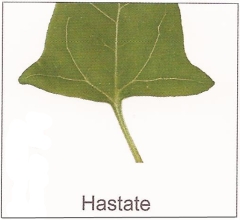
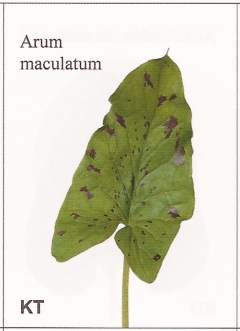
- … [12] All leaves on long (10-20cm) stout stalks, triangular, arrow-shaped, untoothed, blades 10-20cm long, often purple-spotted … Arum maculatum (p 418 E)
Using "The Vegetative Key to the British Flora" (Poland and Clement), ramsons and lily-of-the-valley both key out vegetatively "in three turns of a page" (sharing the same group JD) and are ultimately distinguished by their leaf odour - onion for ramsons and lack of leaf odour for lily-of-the-valley:
"The Vegetative Key to the British Flora" (2009) J. Poland & E. J. Clement
Key to Major Divisions (Based primarily upon the increasing degree of leaf dissection). For herbaceous plants choose a lower or basal leaf unless otherwise instructed. To separate leaves from leaflets, leaflets never have a bud in the axil. 'Leaves' or 'leaf' refers to leaf blade (excluding the petiole).
- Flowering Plant (monocotyledons, dicotyledons)
- Leaves present, not stem-like
- Plant with aerial or emergent leaves (usually land plant)
- Leaves simple (not composed of leaflets)
- Leaf margin entire (or leaves cylindrical)
- Leaves parallel-veined, usually >3 veins visible (stomata often in parallel rows). Usually monocotyledons (may have bulb, corm or viscid sap)
- Ligule and auricles both absent … J
Key to Groups in Division J (Ligule and auricles both absent)
- Herb. Leaves not equitant
- Leaves with distinct petiole
- Plant not emergent from water (may be found in damp habitats). Petiole without latex … JD
Group JD - Leaves with distinct petiole. Plant hairless … Damp or dry habitat …
- Leaves with onion odour, cuneate (occasionally rounded) at base
- Leaves 2(3) per shoot, 10-20 x 1.5-5.5 cm, ± elliptic, acute, twisted, shiny green above, dull below, with crenulate-erose hyaline margins, with opaque veins, with midrib raised below, with stomata below only. Petiole to 7 cm, semi-cylindrical, with 7-11 vascular bundles in shallow arc. Bulbs joined by short rhizomes. March - July … Ramsons Allium ursinum
- Leaves odourless, cordate
- Basal leaves in pairs (occasionally in 3s). Dry habitats
- Leaves to 12 x 3-4(5) cm, elliptic to ovate-lanceolate, acute, rolled when young, ± dull green above, shiny green below, pruinose when young, with hyaline margins, with many translucent parallel veins, with midrib raised below, without cross-veins and viscid sap, with stomata both sides. Lower leaf with closed sheath forming a false-stem. Cataphylls and false-stem purple-spotted. Rhizomatous. April - August … Lily-of-the-Valley Convallaria majalis
Meadow saffron and the bluebell also key out vegetatively "in three turns of a page" as they share the same group (JW) but they differ from ramsons which have opaque leaf veins on leaves which are borne on a distinct petiole (leaf stalk):
"The Vegetative Key to the British Flora" (2009) J. Poland & E. J. Clement
Key to Major Divisions (Based primarily upon the increasing degree of leaf dissection). For herbaceous plants choose a lower or basal leaf unless otherwise instructed. To separate leaves from leaflets, leaflets never have a bud in the axil. 'Leaves' or 'leaf' refers to leaf blade (excluding the petiole).
- Flowering Plant (monocotyledons, dicotyledons)
- Leaves present, not stem-like
- Plant with aerial or emergent leaves (usually land plant)
- Leaves simple (not composed of leaflets)
- Leaf margin entire (or leaves cylindrical)
- Leaves parallel-veined, usually >3 veins visible (stomata often in parallel rows). Usually monocotyledons (may have bulb, corm or viscid sap)
- Ligule and auricles both absent … J
Key to Groups in Division J (Ligule and auricles both absent)
- Herb. Leaves not equitant
- Leaves sessile or narrowing to indistinct petiole
- Leaves without latex
- Leaves not vanilla- or goat-scented
- Leaves alternate (occurring single or in pairs)
- Leaf margins smooth and (±) entire, never ciliate
- At least some leaves basal
- Leaves without a white stripe along midrib above (may have glaucous stripe above)
- Leaves >4mm wide, never 4-angled
- Leaves flat or U-shaped
- Leaf veins (except midrib) not or weakly raised below. Monocotyledon, usually bulbous
- Leaves 3 or more per shoot
- Leaves green above … JW
Group JW - Leaves 3 or more per shoot, all basal … never glaucous. Usually bulbous or tuberous. ① Leaf veins translucent (± obscure and opaque in all other species). ② Bulbs annual without collar lines
- Leaves usually with erose to crenulate hyaline margins (x20)
- Bulbous. Leaves 3-ranked, rolled or channelled when young, with clearly hooded apex, with viscid sap forming strands
- Leaves not ribbed either side
- Leaves 3-8 per bulb, shiny green both sides, without spots below
- Leaves 20-50 cm, flat to channelled, with crenulate hyaline margins (occasionally weak), with midrib raised below (occasionally visible as 2(3) ribs or opaque lines below), with scattered elongate stomata both sides, with viscid spiral fibres when torn. Cataphyll 1. Bulb annual, without collar lines, whitish, without tunic ②
- Leaves 3-6, 0.7-1.6 cm wide. Raceme 1-sided. Flowers all soon nodding, fragrant; stamens unequal; anthers cream. (January) March - June. Woods, cliff tops in west Britain … Bluebell Hyacinthoides non-scripta
- Leaves with entire hyaline margin
- Leaves >2 cm wide
- Bulb or corm, not forming dense clumps of leaves
- Leaves mostly >4 cm wide
- Leaves 2-5, absent at flower, 15-30 x 2-6(7) cm, oblong-lanceolate, slightly hooded at apex, rolled when young, channelled, slightly ribbed both sides, shiny yellow-green both sides, with entire hyaline margins remaining colourless, with midrib raised below, without cross-veins, without hollows, ± without fibres or sap, with scattered elongate stomata both sides. Shoots round, yellowish at base. Cataphylls absent. Cormous. February - July. Damp grassland or woods on basic soils, or hortal (plant of garden origin) … Meadow Saffron Colchicum autumnale
Lords-and-ladies also keys out vegetatively "in three turns of a page" but the plant is assigned to group KT by reason of its pinnate-veined leaves (characteristic of dicotyledons) in contrast to the parallel-veined leaves of ramsons, lily-of-the-valley and meadow saffron which are characteristic of such monocotyledons. Although ramsons and lords-and-ladies are both described as being hairless with shiny green leaves, they differ in leaf shape, leaf base and leaf venation characteristics with the leaves of lords-and-ladies being net-veined and often "black-blotched". Notwithstanding that the specific name maculatum means 'spotted' or 'blotched', not every lords-and-ladies plant exhibits black-blotched leaves and black-blotching is also rare on the leaves of Italian lords-and-ladies (Arum italicum subspecies italicum and neglectum):
"The Vegetative Key to the British Flora" (2009) J. Poland & E. J. Clement
Key to Major Divisions (Based primarily upon the increasing degree of leaf dissection). For herbaceous plants choose a lower or basal leaf unless otherwise instructed. To separate leaves from leaflets, leaflets never have a bud in the axil. 'Leaves' or 'leaf' refers to leaf blade (excluding the petiole).
- Flowering Plant (monocotyledons, dicotyledons)
- Leaves present, not stem-like
- Plant with aerial or emergent leaves (usually land plant)
- Leaves simple (not composed of leaflets)
- Leaf margin entire (or leaves cylindrical)
- Leaves pinnate-veined (or 0-3 parallel veins), occasionally obscurely so or palmately veined. Usually dicotyledons (very rarely with bulb, corm or viscid sap)
- Leaves alternate … K
Key to Groups in Division K (Leaves entire, alternate)
- Herb, occasionally ± woody at base, never climbing. (Many bulbous plants may key out here in error)
- Latex absent
- Leaves not spiny (may be bristly)
- Leaves (and stem if present) totally hairless
- Leaves with pinnate veins (occasionally obscure or palmate)
- Leaves in basal rosette … KT
Group KT - Leaves in basal rosette (or plant stoloniferous in freshwater habitats), hairless, pinnate-veined. Stipules absent but if ochreae (or remains) present (Polygonaceae) GO TO Dock …
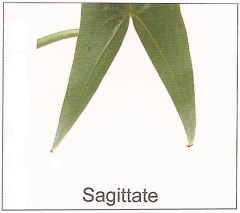
- Basal leaves sagittate or hastate (stem leaves never present). Monocotyledon
- Leaf apex without long drip-tip (may have apiculus <5 mm). Rhizomatous perennial
- Dry, often shady, habitats. Leaves rolled when young, shiny dark green, ± net-veined, with veins anastomosing and forming submarginal vein, with stomata both sides. Petiole 10-20 cm, with sheathing base, channelled, with vascula bundles scattered throughout aerenchyma. Cataphylls large, white (often smaller cataphylls present in connate pairs)
- Leaves (2)4-8, with pale whitish colouration along midrib and 2° veins
- Leaves October - July, 10-35 cm, rarely with black blotches, with rounded lobes at base. Strongly rhizomatous (patch forming) … Italian Lords-and-Ladies Arum italicum subspecies italicum
- Leaves 2-3(6) completely green
- Leaves October - July, 10-35 cm, very rarely black-blotched, with rounded lobes at base. Strongly rhizomatous (patch forming) … Italian Lords-and-Ladies subspecies Arum italicum subspecies neglectum
- Leaves January - July, to 15 cm, often black-blotched, with ± acute lobes at base. Weakly rhizomatous … Plate 14 … Lords-and-Ladies Arum maculatum
Poisoning incidence
For further information regarding the poisonous nature of these four plants and the serious risk they pose of illness, injury, or death to humans and animals see:
- Convallaria majalis (lily-of-the-valley, May lily)
- Colchicum autumnale (meadow saffron, autumn crocus, naked lady)
- Arum maculatum (lords-and-ladies, friar's cowl, adder's root, cuckoo pint)
- Ornithogalum umbellatum, (the star-of-Bethlehem, grass lily, nap-at-noon, eleven-o'clock lady)
Ramsons
(wild garlic)
Allium ursinum
edibleLily-of-the-valley
(May lily)
Convallaria majalis
poisonousMeadow saffron
(autumn crocus, naked lady)
Colchicum autumnale
poisonousLords-and-ladies
(cuckoo pint, friar's cowl)
Arum maculatum
poisonous
Star-of-Bethlehem
(grass lily, nap-at-noon, eleven-o'clock lady)
Ornithogalum umbellatum
poisonousOrnithogalum umbellatum (Star-of-Bethlehem, grass lily, nap-at-noon, eleven-o'clock lady)
The plant, especially the bulb and flowers, contains cardiac glycosides, specifically convallatoxin and convalloside which are toxic to humans, pets and livestock. Symptoms of poisoning include nausea, salivation, vomiting, diarrhea, and shortness of breath, as well as pain, burning, and swelling of lips, tongue, and throat. Prolonged contact may lead to skin irritation and, in a recent case, the death of an eight-month-old puppy.
Ornithogalum umbellatum is thermoperiodic, requiring a cold winter to complete its life cycle. It first appears in early spring as tufts of leaves, prior to flowering (proteranthous), which occurs in late spring (May-June), the leaves fading prior to blooming. It reproduces by its bulbs, which form many offsetting bulbils that can be dispersed by water. Like many bulb plants from temperate regions, a period of exposure to cold is necessary before spring growth can begin. This protects the plant from growth during winter when intense cold may damage it. Warmer spring temperatures then initiate growth from the bulb. Ornithogalum umbellatum spreads aggressively in clumps by means of these offsets.
The plant can easily be mistaken for wild garlic, due to its similar, shiny, dark green leaves, which can reach up to 12 inches in height, and up to 2½ inches wide. However, unlike wild garlic, the leaves of Ornithogalum umbellatum have a distinctive white midrib, or vein and produces white flowers with six petals that collectively resemble a star similar to the inflorescence of wild garlic, the star-like, pure white flowers of which grow singly on short radiating stalks at the end of each stem. The flowers of Ornithogalum umbellatum are insect-pollinated, but may also be self-fertile, forming seeds in summer (June–July).
Convallaria majalis (Lily-of-the-valley, May lily, May bells, Our Lady's tears, Mary's tears)
The plant contains three glycosides; convallarin, convallamarin, and convallotoxin. Convallotoxin is one of the most active natural substances affecting the heart. It causes irregular, slow pulse rates and can cause heart failure. In addition, the plant contains saponins which cause gastrointestinal poisoning.
In spite of its high toxicity there is only one recorded case of poisoning where, in 1989, a family of four ate the bulbs thinking they were part of the onion family. The paper reporting this case talks of 'digitalis-like toxicity'. The alleged poisoning of a three year old, in 1981, from drinking water from a vase which had contained Convallaria majalis, has not been confirmed by experimentation. A 1996 paper found that suspected Convallaria majalis poisoning was one of the top three causes of hospital admissions for suspected plant poisoning in a five year period in Finland. It is said, however, that of the 71 total hospital admissions for all plants only 11% were confirmed as plant poisoning.
Colchicum autumnale (meadow saffron, autumn crocus, naked lady)
Contains colchicine and colchiceine, the former being the more toxic and more harmful. Following ingestion, initial gastrointestinal symptoms during the first 24 hours are followed by more severe effects including convulsions, cardiovascular collapse, multi-organ failure and blood clots forming in many places around the body. New symptoms may occur after several days. Muscular weakness and ascending paralysis cause respiratory arrest. The effects have been described as very similar to cholera leading to a slow, agonising death but consciousness remains to the end.
Ingestion of the plant in mistake for wild garlic has caused deaths - see "Fatal colchicine poisoning by accidental ingestion of meadow saffron - case report" Forensic Science International 149 (2005) at pages 253 to 256:
"A 62-year-old male died of colchicine poisoning after accidental ingestion of Colchicum autumnale (meadow saffron). He ate a salad of plant with green leaves regarded as wild garlic (Allium ursinum). A few hours later he developed symptoms of gastroenteritis and was admitted to hospital. In spite of gastric lavage, activated charcoal and supportive measures, multi-organ system failure developed over the next two days. Laboratory analysis showed highly elevated blood concentrations of hepatic enzymes, creatine kinase, lactate dehydrogenase and blood urea nitrogen, as well as leukocytopenia and thrombocytopenia. Mechanical ventilation, dopamine, noradrenaline, crystalloid solutions and fresh frozen plasma were applied but despite treatment the patient died five days after the ingestion. Post-mortem examination revealed hepatic centrilobular necrosis, nephrotoxic acute tubular necrosis, petechial bleeding in fatty tissue, blunt and shortened intestinal villi and cerebral toxic edema. Botanical identification of incriminated plant gave Colchicum autumnale which confirmed colchicine poisoning. Although the accidental ingestion of Colchicum autumnale is rare and to our knowledge only five such cases have been described in detail, this is the second fatal case in Croatia described in the last 3 years."
In 2003, a 76 year old man with a history of alcoholism ate the plant in mistake for wild garlic. He suffered renal and liver failure and died from cardiovascular collapse and respiratory failure. Some years before, in Central Europe, two people were poisoned by eating Colchicum autumnale instead of wild garlic. One died after 48 hours of heart, kidney, liver and lung failure whereas the other recovered after three days of severe gastro-intestinal upset. A 71 year old woman, from Slovenia, survived after mistaking Colchicum for wild garlic but only after exhibiting new symptoms up to three weeks after ingestion when her hair fell out. Another victim reported episodes of hair loss up to three years after ingestion.
In 2003, a toxicology conference heard a report of a case, in Switzerland, where a 3 year-old died five hours after admission to hospital following two days of stomach upset. At the time, death was attributed to Reye syndrome but, a year later, a relative heard of a case of colchicum poisoning and asked for a fresh investigation. Colchicum was found growing where the child had been seen playing and picking leaves and a tissue sample, held in the lab, tested positive for colchicine.
Crocus sativus, commonly known as 'saffron crocus' or 'autumn crocus', is a species of flowering plant of the Crocus genus in the Iridaceae family. It is best known for producing the spice saffron from the filaments that grow inside the flower. The term 'autumn crocus' is also mistakenly used for Colchicum autumnale (also called 'meadow saffron') which is poisonous. However, crocuses have 3 stamens and 1 style, while colchicum have 6 stamens and 3 styles and are toxic. Stigmas of Crocus sativus should be harvested mid-morning when the flowers are fully opened.
Arum maculatum (lords-and-ladies, cuckoo-pint, friar's cowl, adder's root, snakeshead, arum, wild arum, arum lily, devils and angels, cows and bulls, soldiers diddies, priest's pintle, Adam and Eve, bobbins, naked girls, naked boys, starch-root, wake robin, sonsie-give-us-your-hand, jack in the pulpit, cheese and toast)
In the UK during a four year period from 1996 to 1999, there were 23 visits to hospital resulting from poisoning by plants from the Arum genus. None resulted in serious harm. The only genus recording a higher total was the Solanum with 31 cases. A young child ate some Arum berries which her grandmother thought were deadly nightshade. She was given a block of salt to eat to ensure she vomited them up. All she remembered was the appalling taste of the salt. A young woman decided to eat a leaf from Arum maculatum. Even though she spat it out when she found how unpleasant the taste was, her mouth and cheeks became irritated and sore for a couple of days.
Why is everyone obsessed with going 'wild' ?, Julie Burchill, The Spectator, 8th February 2020
… But another of my dearest friends was once a keen 'forager' and her experience proves there is no such thing as a free lunch, especially when scrounged from hedgerows: "Once I foraged a lot of wild garlic and gave bags of it to all my friends. But when I got home and washed mine I realised I had picked a plant that looks like garlic when young, called 'Lords and Ladies', which can lead to swelling of the throat and difficulty in breathing. I rushed round to get them all back …
Ramsons and lords-and-ladies in late March 2019 (Kearsney Abbey, Dover, Kent)
Ramsons and lords-and-ladies on 31st March 2022 at Kearsney Abbey, Dover, Kent

Caveat pabulator ('Forager beware') [2]
As the various floras demonstrate, the key to accurate identification of these four plants when not in flower is their distinguishing leaf characteristics; the onion smell of wild garlic and the absence thereof in the May lily, the naked lady's lack of a leaf stalk (petiole) and the net-venation (or black-blotching) of friar's cowl leaves.
To assist foragers - and to mark the 192nd anniversary of Emily Dickinson's death (age 55) on 15th May 1886 - I have penned a cautionary common or hymn metre quatrain (8-6-8-6, abab) [3] based on these specific 'foliar' attributes which, if committed to memory and recited when foraging for ramsons - e.g. to the tune of 'Amazing Grace' - should preclude mistaken identification:
Wild garlic leaves of onion whiff,
May lily ne'er smells foul;
the naked lady's sessile leaf,
net-veined the friar's cowl.[2] Pabulator, pabulatoris (genitive singular) 'a forager' from pabulor ('I eat fodder, graze, forage'), from pabulum ('food, nourishment, fodder') - see Titus Livius (Livy), The History of Rome, Book 5 Chapter 43.5
[3] A most suitable title for this "bear's garlic" quatrain would be I pull a flower from the woods - line 9 of 'Arcturus' is his other name - I'd rather call him 'Star' by Emily Dickinson (fascicle 83) the third stanza of which is:
I pull a flower from the woods-,
A monster with a glass
Computes the stamens in a breath-
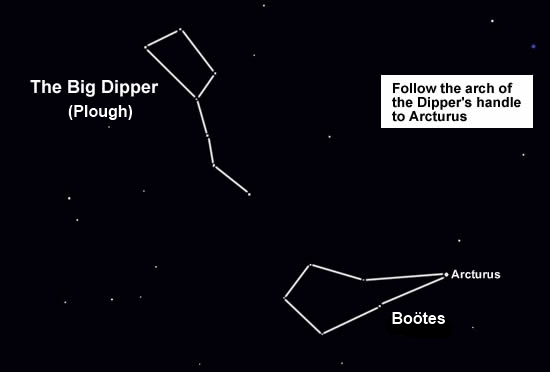
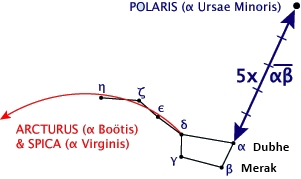
And has her in a 'class'!The name Arcturus derives from Ancient Greek 'Arktouros' and means 'Guardian of the Bear', ultimately from 'arktos' (bear) and 'ouros' (watcher, guardian). It has been known by this name since at least the time of Hesiod (active between 750 and 650 BC). This is a reference to its being the brightest star in the constellation of Boötes (whose rising and setting was supposed to portend tempestuous weather) which is next to the constellations of Ursa Major and Ursa Minor, respectively the Greater and Lesser Bears.
The constellation Boötes, the herdsman, is one of the oldest constellations and home to the fourth brightest star in the sky - Arcturus.
Chart (above) showing the relationship of Polaris (the North Star) and Arcturus (the herdsman), respectively the brightest and fourth brightest stars in the sky, with the constellations Boötes, Ursa Major and Ursa Minor. Dubhe derives from the Arabic for 'bear', dubb, from the phrase zahr ad-dubb al-akbar, 'the back of the Greater Bear', and Merak derives from the Arabic al-maraqq, 'the loins' (of the bear). Old Norse Stjarna, 'a star' may also mean Arcturus; vagn-stjarna, 'the wain-star' i. e. Arcturus. The name "bear" is Homeric, and apparently native to Greece, while the "wain" tradition is Mesopotamian. Book XVIII of Homer's Iliad mentions it as "the Bear, which men also call the Wain".
Mnemonic: "Arc to Arcturus then spike to Spica"
Legal considerations
Wildlife and Countryside Act 1981 (WCA 1981) section 13 prescribes measures for the protection of wild plants through prohibition of:
- the intentional uprooting of any wild plant species without the authority of the owner or occupier of the land, and
- any picking, uprooting, destruction or sale of plants (or their derivatives) listed on Schedule 8.
The provisions of WCA 1981 section 13 and Schedule 8 apply to England, Scotland and Wales but do not extend to Northern Ireland.
By section 2(1) of the Countryside and Rights of Way Act 2000 (CROW 2000), any person may enter and remain on any "access land" (defined in section 1(1) as "open country" comprising mountain, moor, heath, down and registered common land) for the purposes of "open-air recreation" (not defined) provided s/he:
- does so without breaking or damaging any wall, fence, hedge, stile or gate, and
- does not intentionally remove, damage or destroy any plant, shrub, tree or root or any part thereof, being the general plant-related restrictions proscribed in CROW 2000 Schedule 2(1)(l).
By section 1(1)(da) of CROW 2000, "access land" includes any land specified by the Secretary of State under section 3A(1) as:
- coastal margin, namely, "the English coastal route" as defined in, and secured pursuant to, section 296 of the Marine and Coastal Access Act 2009 (MCAA 2009), and
- adjacent 'coastal land', defined by CROW 2000 section 3A(10) as (a) the foreshore defined in section 147 of the MCAA 2009 as "land which is covered and uncovered by the ordinary movement of the tide", and (b) land adjacent to the foreshore including any cliff, bank, barrier, dune, beach or flat.
Under section 2(4), any person in breach of these restrictions will lose their right to roam on "access land" in the same ownership for a period of 72 hours and may be treated as a trespasser by the owner of the "access land". Although breach of a restriction will not, in and of itself, constitute a criminal offence, some of the activities set out in Schedule 2 may constitute criminal offences under other legislation e.g. WCA 1981 sections 13(1)(a), 13(1)(b), 13(3) and Schedule 8: see Wildlife Offences.
In short, CROW 2000 and MCAA 2009 together create:
- a right to roam on "access land" for the purposes of "open-air recreation"; and
- an offence to forage on "access land" in which any part of a plant is intentionally removed, damaged or destroyed.
Save in respect of "access land", it is not an offence to pick the 'Four Fs' (fruit, foliage, fungi or flowers where not specifically protected) which are growing wild if they are for personal use and not for sale. This is not part of WCA 1981 but a part of common law - see also below Theft Act 1968 (TA 1968) section 4(3) and Criminal Damage Act 1971 (CDA 1971) section 1(1). It covers such customs as blackberry-picking, taking ivy and holly at Christmas, mushroom-hunting and gathering sloes. To exercise this right you must be somewhere you have a legal right to be, such as on a public footpath or in a public park. You cannot just go anywhere and pick the "Four Fs". In some places, such as parks or commons, local byelaws prevent such activities.
TA 1968 section 4(3) specifically provides that a person who picks mushrooms growing wild on any land, or who picks flowers, fruit or foliage from a plant growing wild on any land, does not (although not in possession of the land) steal what he picks, unless he does it for reward or for sale or other commercial purpose, and, for purposes of this sub-section "mushroom" includes any fungus, and "plant" includes any shrub or tree. By section 7, a person guilty of theft shall, on conviction on indictment, be liable to imprisonment for a term not exceeding ten years.
This statutory exemption is also enacted in CDA 1971 section 10(1) which provides that, for the purposes of the CDA 1971, "property" does not include:
- mushrooms (defined as any fungus), or
- flowers, fruit or foliage of a plant (including any shrub or tree)
growing wild on any land. For the purposes of this subsection 'mushroom' includes any fungus and 'plant' includes any shrub or tree.
CDA 1971 section 1(1) otherwise provides that a person who without lawful excuse destroys or damages any property belonging to another, intending to destroy or damage any such property, or being reckless as to whether any such property would be destroyed or damaged, shall be guilty of an offence which is triable either way and for which the maximum penalty is 10 years imprisonment - CDA 1971 section 4.
In summary, the common law right to pick the "Four Fs" (fruit, foliage, fungi or flowers) for personal use only is:
- superseded by any specific protection afforded by WCA 1981;
- prohibited by local byelaws forbidding such activities; and
- proscribed on land made accessible through CROW 2000 or MCAA 2009.
'It's trendy': wild garlic foragers leave bad taste in mouth of Cornish residents Steven Morris, The Guardian, 24th March 2022
Patrols suggested as residents say foragers collecting large bags of wild garlic are ruining annual supply.
Usually in the springtime, Millham Lane in the Cornish town of Lostwithiel is flanked by thick, unbroken banks of strongly scented wild garlic. But this year ugly gaps have appeared in the bright green swathe after they were stripped by foragers - apparently professionals - intent on sourcing a fresh, free ingredient for fashionable dishes such as wild garlic pesto. Usually in the springtime, Millham Lane in the Cornish town of Lostwithiel is flanked by thick, unbroken banks of strongly scented wild garlic. But this year ugly gaps have appeared in the bright green swathe after they were stripped by foragers – apparently professionals – intent on sourcing a fresh, free ingredient for fashionable dishes such as wild garlic pesto. The situation has become so acute that the local council has suggested that people take down car registration numbers and contact the police if they spot foragers, and some townsfolk have mooted organising wild garlic patrols.
Rachel Fisher, who often walks on the lane, said:
"It is awash with wild garlic every year. Local people, myself included, forage a bit but it never looks hacked to bits. When it's a few local people it's fine. I was walking down the lane and saw a young man with a knife and very large bag and he was filling it up with garlic. I assumed he was a restaurateur and asked him where he was based. He said up near Bodmin, which is about seven miles away. I asked, wouldn't it be easier to get your garlic from closer to home? Why are you here? He laughed and said: 'We’ve destroyed it all.' I gave him a look and told him: 'Try not to destroy our garlic'."
Fisher had what she calls a 'rant' on a community Facebook page calling for people to 'share and share alike'. But she said:
"The feed went a little bit bonkers. It touched a nerve. It's very trendy to have wild garlic pesto and things like that, but foraging on that scale is not right. There are big holes, gashes in this lane of garlic, which is usually very beautiful. It hasn't even come into flower yet so it's not had a chance to reproduce. It's not coming back this year, who knows if it will next. "
The laws around foraging are complex but, in general, it is legal to forage for personal consumption but not for commercial gain.
After the post appeared on Facebook, people from Bodmin got in touch to say their garlic - which is good in soups and salads as well as to make pesto - had been vanishing, too.
Another Lostwithiel resident, Joannie Muskett, said she had come across two people, one in his 20s, one in his 50s, gathering garlic.
"The younger guy had a knife 6-8ins long that he was using and they had two full clear bin bags with the garlic squashed into it. We may need to start patrols to stop them."
Colin Martin, the Cornwall councillor for Lostwithiel, said he was worried that the foragers might be being exploited by the people they were harvesting the garlic for.
"They might be making a pittance and not know what they are doing is illegal. They might be the victim of someone pulling the strings. The feeling here is that if anyone sees it happening they should either consider speaking to the individual or take a vehicle registration number and contact the police."
The situation has become so acute that the local councillor has suggested that people take down car registration numbers and contact the police if they spot foragers, and some townsfolk have mooted organising wild garlic patrols.
See pages 17 to 28 of "The Forager's Calendar", a seasonal guide to Nature's wild harvests (2020) John Wright, in particular, the Summary at pages 27 and 28:
Summary
There is a general right to collect the 'four Fs' - fruit, flowers, foliage and fungi - from any land, provided it is growing wild and that you do it for your personal use. This does not apply to seaweeds, though any detached seaweeds still floating in the sea are legally collectable.
This right does not, generally, apply to land designated under the Countryside and Rights of Way Act 2000 (CROW 2000), except where there is a footpath or other historic right of way or access, when the right to forage is retained.
Trespassing is a 'civil wrong', not a criminal offence, though you could in theory (and very occasionally in practice) be sued for the value of your occupation. You should not trespass, and if challenged for doing so, you must leave by the nearest exit. Anything you have foraged while you were there is yours and cannot be legally confiscated.
It is illegal under the Wildlife and Countryside Act (WCA 1981) to remove an entire plant (uproot) without permission from the landowner.
There is usually a prohibition on removing any organism from land designated a Site of Special Scientific Interest (SSSI), though the governing authority is often fairly relaxed about low-level and sensible foraging and would need to prove damage to take action against you.
You should never carry a knife which has a lockable blade over 3 inches (7.5 cm) long, or a blade of any length which is fixed, unless you are confident that you can convince any officer of the law that you have a good (legal) reason to have it.
A note about knives
Subject to the statutory and regulatory restrictions outlined above, when harvesting foods it is far better to cut the plant because it causes less damage, and you might also want to cut, peel and eat it on the spot. It is not unlawful to carry a knife provided that it conforms to certain restrictions.
It is legal to carry a "non-lockable", folding pocket-knife if the cutting edge of its blade does not exceed three (3) inches - see Criminal Justice Act 1988 section 139(3) as applied in the decision of the Court of Appeal (Criminal Division) in R v Deegan (1998).
Generally the following restrictions apply:
- no knife can be carried on any school premises (Offensive Weapons Act 1996 section 4)
- it must not be an 'automatic' or 'gravity' opened flick or butterfly knife (Offensive Weapons Act 1959 section 1)
- it must not be disguised as something innocent (Criminal Justice Act 1988 section 141 as amended by The Criminal Justice Act 1988 (Offensive Weapons) Orders 1988 and 2002)
- a folding pocket-knife which is capable of being locked open is a bladed article for the purposes of section 139 of the Criminal Justice Act 1988 (Harris v DPP and Fehmi v DPP)
Note that any knife which is not banned (see above) or has a blade longer than three inches (e.g. a hunting knife) can still be carried in public provided you have a "good reason or lawful authority" for doing so - Criminal Justice Act 1988 section 139(4).
Criminal Justice Act 1988 section 139(1) provides that, subject to the defences prescribed in sub-sections (4) and (5), a person who has any article which has a blade or is sharply pointed (except a non-lockable, folding pocket-knife with a blade the cutting edge of which does not exceed 3 inches) with him in a public place (i.e. any place to which at the material time the public have or are permitted access, whether on payment or otherwise) shall be guilty of an offence.
It shall be a defence for a person charged with an offence under section 139(1) to prove that he had
- good reason or lawful authority for having the article with him in a public place - section 139(4);
- the article with him (a) for use at work, (b) for religious reasons or (c) as part of any national costume - section 139(5).
The offence under Criminal Justice Act 1988 section 139(1), punishable under sub-section 139(6) on summary conviction to a fine "not exceeding level 3 on the standard scale", was increased by section 3 of the Offensive Weapons Act 1996:
- on summary conviction, to imprisonment for a term not exceeding six months, or a fine not exceeding the statutory maximum, or both;
- on conviction on indictment, to imprisonment for a term not exceeding two years (increased to four years by section 42(1)(a) of the Violent Crime Reduction Act 2006), or a fine, or both.
By the provisions of Section 139(6A)-(6G), inserted on 17th July 2015 by sections 28(5) and 95(1) of the Criminal Justice and Courts Act 2015, where a person:
- is convicted of an offence under subsection 139(1), and
- when the offence was committed the person was aged 16 or over and had at least one relevant conviction,
the court must impose an appropriate custodial sentence (with or without a fine) unless the court is of the opinion that there are particular circumstances which:
- relate to the offence, to the previous offence or to the offender, and
- would make it unjust to do so in all the circumstances.
Culinary and medicinal use
"Herbal Simples approved for modern uses of cure" (1895) W.T. Fernie M.D. at page 221
Preface to the first edition
… It may happen that one or another enquirer taking up this book will ask, to begin with, "What is a Herbal Simple?" The English word "Simple," composed of two Latin words, 'Singula plica' (a single fold), means "singleness," whether of material or purpose.
From primitive times the term "Herbal Simple" has been applied to any homely curative remedy consisting of one ingredient only, and that of a vegetable nature. Many such a native medicine found favour and success with our single-minded forefathers, this being the "reverent simplicity of ancienter times" … a trite proverb of former times bids us:
"Eate leekes in Lide [4] and ramsins in May,
And all the yeare after physitians may play."Ramsons (Allium ursinum, fl. albo); tast like garlick: they grow much in Cranbourn Chace.
"The Naturall Historie of Wiltshire" (1691 and 1848) John Aubrey, Bodleian MSS Aubrey 1 and 2 at page 51 and "Dictionary of Archaic Words" (1989) J. O. Halliwell at page 666.
Ramsons, or the Wild Garlic (Allium ursinum), is broad leaved and grows abundantly on our moist meadow banks, with a strong smell of onions when crushed or bruised. It is perennial, having egg-shaped or lance-like leaves, whilst bearing large, pearly-white blossoms with acute petals. The name is the plural of "Ramse" or "Ram" which signifies strong-smelling or rank. And the plant is also called "Buck Rams" or "Buck Rampe" in allusion to its spadix or spathe. "The leaves of Ramsons", says Gerard, "are stamped and eaten with fish, even as we do eat greene sauce made with sorrell." This is "Bear's Garlic" and the Star Flower of florists.
[4] Lide is Anglo-Saxon for March.
Allium ursinum is an excellent companion plant in the garden, it grows well with most plants and seems to positively affect their health and their ability to resist pests and diseases. It does not seem to grow so well with plants in the pea and bean family, however, with many gardeners noticing reduced growth and vigour in both species.
All parts of this plant are edible in quantity when it is in season. The leaves are delicious raw or cooked and can be harvested as early as the middle of January in mild winters. They have a distinct garlic flavour, though are milder than garlic cloves, and really add something special to a winter salad. When cooked, they are normally used as a flavouring in soups, stews etc, though can be used like spinach.
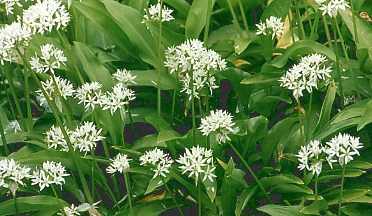
As the flowers begin to open in the middle of spring, the leaves start to lose their vitality. At this time transfer your attention to the flowers, using them in exactly the same way as the leaves. They have a somewhat stronger flavour and make a decorative and very tasty addition to salads. The flowering heads can still be eaten as the seed pods are forming, though the flavour gets even stronger as the seeds ripen.
From the health perspective, wild garlic has most of the benefits of the cultivated garlic, Allium sativum. It is therefore a very beneficial addition to the diet, promoting the general health of the body when used regularly. It is particularly effective in reducing high blood pressure and blood cholesterol levels.
The juice of the plant has been used as a general household disinfectant and has antibacterial and antifungal properties, as well as antioxidant properties, that protect against free radicals. It may activate macrophages to reduce the synthesis of LDL cholesterol and protect against plaques and blood clots. Adenosine acts as a muscle relaxant and as a protectant against poisons, such as caffeine. It helps increase blood vessel width and can also reduce platelet aggregation (blood stickiness).
In 1992 Allium ursinum was declared the "Medicinal Plant of the Year" by the Association for the Protection and Research on European Medicinal Plants. Allium ursinum has all the benefits of Allium sativum products on the market but also has three advantages over this domesticated garlic:
- it has more of the active substances
- it has active substances not found in cultivated garlic, or found only when large quantities are taken
- it is odourless
Click here to view "Allium ursinum: botanical, phytochemical and pharmacological overview"
"Herbs and Healing Plants of Britain & Europe" (1996) Dieter Podlech at page 128
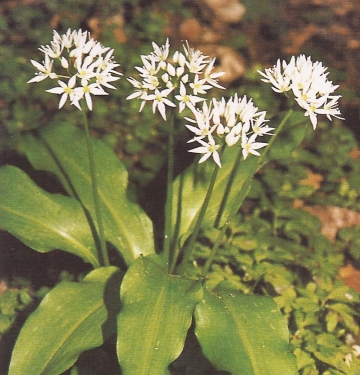
Ramsons/Wild Garlic
Allium ursinum (Lily Family)
Hairless perennial to about 50 cm tall, with erect, unbranched stem; usually grows in large colonies. Leaves all basal, normally 2, to 20 cm long, broadly lanceolate, pointed and long-stalked. Inflorescence a terminal umbel, at first encased in papery bracts which soon fall away. Flowers stalked and star-shaped, with 6 perianth segments 8-12 cm long. 6 stamens. Fruit a 3-lobed capsule.
Flowering season: April - June
Habitat: Damp woods, hedges, shady damp meadows, streamsides.
Distribution: Much of Europe, east to the Caucasus; N Asia.
Active ingredients: Essential oils (containing sulphur), vitamin C, allicin, iron.
Uses: To treat digestive problems, rheumatism, high blood pressure and asthma.
Further uses: Fresh leaves in salads, soups and with soft cheese.
Home use tips: For loss of appetite or digestive disorders, eat fresh leaves chopped up small.
NB: Easily confused when not flowering with the poisonous Lily-of-the-valley, but the garlic smell of ramsons when crushed is distinctive.
Note: Many species of the genus Allium contain strong-smelling and sharp-tasting oils in all parts of the plant. The value of these compounds to the plants is not known for certain but they probably help protect them from being eaten by animals. Ramsons, along with Garlic, is one of the most strong smelling of all Allium species.
Journal of Medicinal Plants Research, Volume 5 (10) at pages 2041-2046, Marcel Pârvu et al, 18th May 2011
Antifungal properties of Allium ursinum
Summary: Allicin analysis of Allium ursinum L. flower and leaf ethanol extracts by LC-MS and in vitro germination and growth inhibition effects on Aspergillus niger, Botrytis cinerea, Botrytis paeoniae, Fusarium oxysporum Fusarium oxysporum tulipae, Penicillium gladioli, and Sclerotinia sclerotiorum were performed.
In conclusion, three main original results regarding the antifungal effect of Allium ursinum flower and leaf extracts against some phytopathogenic fungi have been reported in the present study: (i) the flower extract has a stronger inhibitory activity than that of the leaf extract; (ii) Allium ursinum flower extract has a high allicin content; (iii) the antifungal activity is positively correlated to the allicin content. These data may be helpful in the development of new natural antifungal products.
Editor's notes:
- Allicin is a compound produced when garlic is crushed or chopped. Available in dietary supplement form, it has been found to reduce inflammation and offer antioxidant benefits. Fresh garlic contains an amino acid called alliin. When the clove is crushed or chopped, an enzyme, alliinase, is released. Alliin and alliinase interact to form allicin, which is considered the major biologically active component of garlic.
- Liquid chromatography-mass spectrometry (LC-MS) is an analytical chemistry technique that combines the physical separation capabilities of liquid chromatography (or HPLC) with the mass analysis capabilities of mass spectrometry (MS).
- In botany and zoology, the abbreviation L. is used to indicate Linnaeus as the authority for a species' name.
Ramsons in poetry
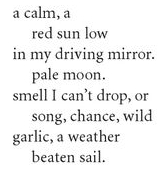
Ramsons is a poem by Richard Caddel (13 July 1949 - 1 April 2003) from "Magpie Words: Selected Poems 1970-2000" published in 2002 by West House Books.
Ramsons is reviewed by Peter Quartermain in "Stubborn Poetries: Poetic Facticity and the Avant-Garde" (2013):
"… ramsons (a plural) is current in speech though uncommon in written work, persistent like the smell the poem records. It comes from OE hramsan, the plural form of hramsa, wild broad-leafed garlic, allium ursinum, it is a pluralized plural and the poem is an act of retrieval, a reminder of the world outside the book. The now of things, the everyday - the apparently casual throwaway that eludes discard - inescapably includes memory, lingers in possession, and in possession carries with it history, memory, that weather-beaten sail …"
Richard Ivo Caddel (The Guardian, 18th April 2003) and (British-Irish Poets Archives, 15th April 2003).
Wild Garlic is a poem by Mary MacRae (1942 - 2009) from "Inside the Brightness of Red" published in 2010 by Second Light Publications:
Allium ursinum, ramson, sometimes ransom,
Old English hramsa: all Northern Europe
has a name for wild garlic, that startling white,
its pungency. Pick and they quickly fade
but in the mass - and what mass! - overwhelming.
In Cornwall they form thick banks along the lanes
and fill damp woods, making me long to be
propped on beds of amaranth and moly -
and truly I find they're magic: the moly-garlic
Hermes gave Odysseus to protect him.
Now hostage to fortune, how willingly
I'd pay a king's ransom - in ramsons, of course,
whole armfuls of them, a wild cornucopia -
for the smallest chance of release, remission.Mary Macrae (The Poet by Day, 9th April 2011) and (Second Light Live).
Ramsdale place-name
The North Yorkshire place-name and English surname Ramsdale is (locative) (both toponymic and topographical) in origin (1) belonging to that group of surnames derived from the place where the original bearer once dwelt or where he once held land, and (2) likely also derived from 'ramsons', being a widespread colloquial name for wild garlic (Allium ursinum) the derivation of which is:
- the Old English word hramsa meaning 'onion, garlic, ramsons, wild garlic' and 'rank' - the butter and milk of cows which have eaten Ramsons is said to be bitter (rank)
- the Old English word dæl meaning 'valley, dale'
combining as Old English hramsa dæl to give 'wild garlic valley'.
Alternatively
- Old Norse hramsa ('bitter') and dalr ('dale, valley') together giving Old Norse hramsa dalr is a Scandinavianised form of Old English hramsa dæl;
- Old Norse 'hrafn' (a raven) (hrafns, genitive singular) traced back to, and often spelt, hramn (hramns) according to the morphological rule after which 'n' becomes 'r' after 'm', giving hramns dalr ('ravens valley'). Cognate with Old English hrafn (raven) and Old Saxon hravan;
- the surname Ramsdale derives directly from the Norse place-name Raumsdalr (the valley of the river Rauma in the counties of Oppland and Møre og Romsdal in Norway - modern: Romsdal) an eponym after "Raum the Old" (Old Norse: Raumr inn gamli), son of King Nór, legendary founder of Norway who may have been descendants of the ancient Gothic "Raumii" tribe. Raums Dale is the modern district of Romsdal in the county of Møre og Romsdal. Raum was said to have been ugly, as was his daughter, Bryngerd, who was married to King Álf. Indeed, in Old Norse, raumr means a big and ugly person.
The surname Ramsdale is related etymologically to the surnames Ramsden, Ramsdell, Ramsgill and Ramsbottom, all of which
- derive from the same Old English element hramsa and/or Old Norse element hramns, and
- tend to be associated with Lancashire and Yorkshire.
The most probable source of the surname is Ramsdale Hamlet [NZ 92722 03762] in Fylingdale's Parish, North Yorkshire. This parochial chapelry lies south of Whitby parish and contains the villages of Robin Hood's Bay and Thorpe, or Fyling Thorpe (Presterthorpe, 13th century), and the hamlets of Normanby, Parkgate, Ramsdale, Raw (Fyling Rawe, 16th century), and Stoupe Brow.
The actual derivation of the surname will likely only be discovered through improved Y-DNA testing of males of the Ramsdale surname to more accurately determine their paternal line.
Click here for a detailed review of the historical sources for, and the likely derivation of, the surname Ramsdale.
Useful links
- Wild Garlic, Gooseberries and Me: A chef's stories and recipes from the land (Dennis Cotter, 19 August 1910)
- Season's eatings: wild garlic (The Guardian, 23rd April 2012)
- Herbal Healer: what is ramson? (NWI Times, 3rd April 2013)
- Why wild garlic is good for you (The Guardian, 30th March 2013)
- The wonders of wild garlic (Daily Telegraph, 12th April 2013)
- Ramsbottom, valley of the wild garlic (Northern Soul, 3rd June 2013)
- Get out more: a beginner's guide to wild garlic (Daily Telegraph, 17th May 2014)
- Bluebells? No, wild garlic's our woodland glory (Daily Mail, 15th May 2015)
- Ingredient focus: what is wild garlic (Sally Abé The Independent, 15th April 2016)
- The best ways to cook with wild garlic (The Independent, 7th April 2017)
- Where the wild garlic grows (John Gilbey, The Guardian, 8th May 2017)
- Berries and ramsoms could kill E. coli in piglets (DPig Progress, 18th January 2018)
- Hyperlocal heroes: meet the chefs growing their own (The Guardian, 25th January 2018)
- Gill Meller on the lost art of wild cooking (The Telegraph, 19th April 2018)
- Wild garlic and crow garlic (Royal Horticultural Society)
- Allium ursinum (Plants for a Future)
- Ramsons (Wild Food UK)
- Wild garlic (Ramslök) (Swedish Food)
Wild garlic leaves cover forest floors at the first sign of spring"An alternative strategy taken by many plants is to let leaves die back and spend winter below the ground as seeds or bulbs. Bulb plants respond to the onset of warmth with rapid growth - the extensive early carpets of wild garlic leaves are testament to this".
369 wild garlic recipes
Rice
- Wet and wild garlic risotto (Riverford Organic Farmers)
- Wild garlic and brassica risotto (Allotment Garden)
- Wild dolmades, nettle purée and pickled ramsons buds (Robin Harford, Eat Weeds)
- Wild garlic dolmades (And other recipes blog, 8th May 2008)
- Savoury rice with wild garlic and peas (Allotment to Kitchen, 28th April 2010)
- Wild garlic risotto (Allotment to Kitchen, 7th May 2010)
- Wet and wild garlic risotto (Jane Baxter, The Guardian, 4th April 2011)
- Wild garlic risotto (The Wine Cellar Insider, 10th April 2011)
- Red snapper on wild garlic risotto (Lime or Lemon, 25th March 2012)
- Wild garlic and mushroom risotto (Mint & Rosemary, 10th April 2013)
- Wild garlic spelt risotto (Mark Hix, The Independent, 29th March 2014)
- Black rice with spinach and wild garlic pesto (Savoury Nothings, 31st March 2015)
- Wild garlic pesto risotto (Food to Glow, 22nd April 2015)
- Wild garlic risotto (Demuths Cookery School, 8th March 2016)
- Ultimate wild garlic risotto (or any kind of pasta) (Nella's travelling and cooking blog, 28th March 2016)
- 'Primavera' fried rice ('Vegan JapanEasy', Tim Anderson, 7th March 2020)
- Spring herb risotto and parmesan crisps (Nigel Slater, The Guardian, 19th April 2020)
- Risotto with wild garlic (Darina Allen, Irish Examiner, 30th May 2020)
- Roast squash and wild garlic risotto (Becky Blench, Wicked leeks, 18th March 2021)
- Red pepper paella with wild garlic, almonds, and an olive and orange salad (Becky Blench, Wicked leeks, 18th March 2021)
- Wild garlic risotto (Danilo Cortellini, Metro, 8th April 2021)
- Wet and wild garlic risotto (Jon Hatchman, The London Economic, 26th April 2022)
Pesto
- Wild garlic pesto (Great British Chefs, Food Urchin)
- Vegan wild garlic pesto (Gloucestershire Vegans)
- Wild garlic pesto (BBC Countryfile Magazine)
- Wild garlic pesto (Good Food Channel)
- Wild garlic and walnut pesto (Allotment to Kitchen, 14th April 2010)
- Wild garlic pesto (Brighton Forager, 3rd May 2011)
- Wild garlic and walnut pesto (Hugh Fearnley-Whittingstall, The Guardian, 15th March 2013)
- Wild garlic soup (Ramslökssoppa), wild garlic pesto and wild garlic cream (John Duxbury, Swedish Food, 2014)
- Wild garlic pesto (delicious. April 2014)
- Wild garlic pesto and crumb (The Herb Kitchen, Herb, 2nd April 2015)
- Wild garlic pesto and oil (Anne's Kitchen, 10th May 2015)
- Wild garlic and nettle pesto (Food to Glow, 12th May 2015)
- Two recipes for wild garlic pesto (Paul Quagliana, Shooting UK, 1st April 2016)
- Wild garlic pesto (Tin and Thyme, 8th April 2016)
- How to forage wild garlic and make wild garlic pesto (Woodland Trust, 18th February 2017)
- Wild garlic pesto (James Mackenzie, The Independent, 7th April 2017)
- Wild garlic pesto (Tamal Ray, The Guardian, 7th June 2017)
- Wild garlic pesto spaghetti (vegan) (Kristina Jug and Mitja Bezenšek, One Green Planet, 9th April 2018)
- Spring greens soup with wild garlic pesto (Yotam Ottolenghi, The Guardian, 18th August 2018)
- How to make jersey royals with wild garlic pesto (Julia Platt Leonard, The Independent, 24th May 2019)
- It's wild garlic season - put it to the testo in a very simple pesto (J. P. Mcmahon, The Irish Times, 17th February 2020)
- Wild garlic pesto (Farming Life, 14th March 2020)
- How to make a delicious wild garlic pesto (Tiffany Daneff, Country Life, 28th March 2020)
- Wild garlic pesto (William Murray and James Kavanagh, The Irish Examiner, 1st April 2020)
- Instant whizz of a pesto (Catherine Devaney, The Courier, 28th April 2020
- Wild garlic pesto (Harriet Johnston, Daily Mail, 14th May 2020)
- Wild garlic pesto (Mary Contini, The Scotsman, 15th March 2021)
- Wild spring pesto (Lindsey Bark, Cherokee Phoenix, 15th March 2021)
- Wild garlic pesto (Tom Moggach, Camden New Journal, 18th March 2021)
- Wild garlic pesto (Stephen King, The Courier, 18th April 2021)
- Wild garlic and basil sauce (Nigel Slater, The Guardian, 2nd May 2021)
- Wild garlic and parsley pesto (Tony Naylor, The Guardian, 23rd May 2021)
Soup
- Wild garlic soup (Clodagh McKenna, Good Food Channel)
- Wild garlic soup (Caroline Davey, Cornwall Today)
- Wild garlic soup with goat's curd (Jamie Oliver's Fifteen)
- Wild garlic and potato soup (Riverford Organic Farmers)
- Potato and wild garlic soup (Stackpole Inn Pembroke, The Great Little Places Guide)
- Wild garlic cream soup (Sophie's World)
- Wild garlic and potato soup with garlic butter croutons (delicious. April 2004)
- Potato, bread and wild garlic soup (delicious. May 2007)
- Wild garlic and potato soup (Catherine, Woodlands blog, 20th June 2008)
- Ramson Soup (Picante Cooking, 25th April 2010)
- Wild garlic soup with sparkle flowers (Allotment to Kitchen, 11th May 2010)
- Wild garlic, artichoke and lemon rice (delicious. April 2011)
- Wild garlic soup (delicious. May 2011)
- Wild garlic, courgette and mint soup (Angela Hartnett, The Guardian, 4th April 2012)
- Wilted spring greens with wild garlic (delicious. April 2013)
- Wild garlic soup (Devonium, 14th May 2013)
- Wild garlic and potato soup with garlic butter croutons (delicious. April 2014)
- Fresh and vibrant wild garlic soup with kohlrabi and parmesan (Gusto Mondo, 3rd March 2015)
- Wild garlic and nettle soup (Barney Desmazery, BBC Good Food, April 2015)
- Wild garlic soup (Food to Glow, 20th April 2015)
- Garlic-shoot soup with snails (Independent, 29th May 2015)
- Nettle and wild garlic soup (Pete Lawrence, Saga, 2nd February 2016)
- Wild garlic soup (Demuths Cookery School, 8th March 2016)
- Ultimate wild garlic soup (Nella's travelling and cooking blog, 28th March 2016)
- Wild garlic and cauliflower soup (Planet Veggie, 14th April 2016)
- Swedish fish soup with wild garlic (The Local, 10th March 2017)
- Spinach soup with wild garlic toasts (Adam Gray, The Independent, 7th April 2017)
- Sorrel and wild garlic vegetable soup (The Independent, 20th April 2018)
- Spring greens soup with wild garlic pesto (Yotam Ottolenghi, The Guardian, 18th August 2018)
- Pea and wild garlic soup (Angela Hartnett, Daily Telegraph, 17th March 2019)
- Wild garlic and potato soup is ideal for chilly winter nights (Michelle Townsend, RSVPLive, 20th October 2019)
- Wild garlic and pea soup (Johnny Leake, Merchant Hotel, 9th November 2019)
- Wild garlic soup (Zack Deakins, 1921 Angel Hill, Bury St Edmunds, 2nd March 2020)
- Wild garlic and potato soup (Kirsty Hale, Wicked Leeks Riverford, 24th March 2020)
- Potato, carrot and wild garlic soup (William Murray and James Kavanagh, The Irish Examiner, 1st April 2020)
- Nettle soup (Xanthe Clay, Daily Telegraph, 14th April 2020)
- Nettle, sorrel and wild garlic soup (Olia Hercules, The Calvert Journal, 7th July 2020)
- Wild garlic soup with toasted almonds and sheep's cheese (Clodagh McKenna, Mail Online, 3rd January 2021)
- Watercress and wild garlic soup with crème fraiche (Mark Heirs, The Scotsman, 15th March 2021)
- Fennel and wild garlic soup (Mary Contini, The Herald, 12th April 2021)
- Wild garlic (velouté) soup (Gary Watson, Gordon's Restaurant, The Courier, 25th April 2021)
- Nettle and wild garlic soup (Darina Allen, Irish Examiner, 8 May 2021)
- Creamy wild garlic chilled soup (Dan Smith, the Fordwich Arms, The Times, 19 March 2022)
Pasta
- Wild garlic and sausage fusilli (Jamie Oliver)
- Wild garlic tagliatelle with mussels, clams, chilli and garlic (Jamie Oliver's Fifteen)
- Wild garlic pasta dough (Jamie Oliver's Fifteen)
- Spring mushroom lasagne with wild garlic (Nancy Anne Harbord, Delicious from Scratch)
- Homemade pasta from wild garlic leaf curd (Fergus the Forager blog, 26th June 2009)
- Wild garlic and ricotta gnocchi (Diary of a first child, 24th April 2011)
- Ramsons pesto with wholewheat spaghetti (Angie's Recipes, 26th April 2011)
- Spaghetti with brown mushrooms, green asparagus and Ramsons pesto (RecipesFantasy, 28th June 2011)
- Chicken, goat's cheese and wild garlic cannelloni (delicious. April 2013)
- Filini pasta with asparagus, peas and wild garlic pesto (delicious. April 2014)
- Wild garlic (or ramps) pasta (David Lebovitz, 22nd April 2014)
- Sweet potato gnocchi with wild garlic and sage pesto (Top with Cinnamon, 5th March 2015)
- Wild garlic ravioli with crab (Rachel Khoo, 11th May 2015)
- Wild garlic pasta with broccoli, walnuts and cheese (Food to Glow, 12th May 2015)
- Wild garlic and ricotta ravioli (Demuths Cookery School, 8th March 2016)
- Spinach, wild garlic and ricotta malfatti (Demuths Cookery School, 8th March 2016)
- Wild garlic pesto pappardelle with crispy 'nduja breadcrumbs (delicious. May 2016)
- St George's mushrooms, wild garlic puree, rainbow chard and gnocchi (Tom Hunter, The Guardian, 17th May 2016)
- Wild garlic gnocchi (The Irish Times, 5th April 2017)
- Wild garlic pesto pasta with slow cooked courgettes (Kirsty Hale, Wicked Leeks Riverford, 24th March 2020)
- Pasta pesto: Take yours up a notch with this recipe (Kevin Burke, The Irish Times, 1st April 2020)
- Wild garlic spaghetti (Lilly Higgins, The Irish Times, 18th April 2020)
- Tagliatelle and wild garlic pesto (Dan Coles, Left Lions, 20th May 2020)
- Pasta, peas, pesto and wild garlic (Nigel Slater, The Guardian, 9th June 2020)
- Wild garlic macaroni cheese (Thomasina Miers, The Guardian, 28th March 2022)
- Wild garlic, 'nduja and ricotta ravioli (Meg Houghton-Gilmour, Thursday 21st April 2022)
- Wild garlic pesto pasta (Monday, 21st April 2022)
- Wild garlic and Cornish Yarg gnocchi (Lynher Dairies Cheese Co, 21st April 2022)
Butter
- Potatoes with ramson butter (Sarah Beattie, Vegetarian Living)
- Wild garlic & herb butter (A Life of Geekery, 1st May 2013)
- Wild garlic butter (Fore Adventure, 12th December 2014)
- Wild garlic butter (Barney Desmazery, BBC Good Food, April 2015)
- Wild garlic butter on music paper bread (Barney Desmazery, BBC Good Food, April 2015)
- Herb butter with wild garlic (The Sourdough School, September 2018)
- Wild garlic butter (Catherine Devaney, The Courier, 13th March 2021)
- Wild garlic and watercress butter (Phil Vickery, ITV, 22nd April 2021)
Pickle
- Pickled wild garlic bulbs (Robin Harford, Eat Weeds blog)
- Sweet pickled ramson flower buds (Edible Leeds blog)
- Pickled wild garlic buds (Brighton Forager)
- Lacto-fermented wild garlic (Galloway Wild Foods blog, 3rd May 2014)
- Wild garlic preserved in vinegar or oil (Gusto Mondo, 28th March 2015)
- Pickled wild garlic flower buds (Farming Life, 30th May 2020)
- Pickled cucumbers with wild garlic (Anna Berrill, The Guardian, 5th January 2021)
- Wild garlic salt (Becky Blench,Wicked leeks, 18th March 2021)
Dressing
- How to make wild garlic oil (Great British Chefs)
- Wild garlic mayonnaise (Wild Food UK)
- Wild garlic salad dressing (Monica Wilde, Forager, 25 April 2014)
- Wild garlic mayonnaise (Aspall, Suffolk, 29th May 2015)
- Wild garlic mayonnaise (Pete Biggs, The Independent, 7th April 2017)
- Wild garlic oil (Tommy Banks, The Telegraph, 11th May 2020)
Dips
- Wild garlic dip (Allotment to Kitchen, 25th April 2010)
- Wild garlic salsa verde (Salty Plums, 31st March 2012)
- Ramsons raitziki (Fi Bird, Huffington Post, 2nd March 2015)
- Wild garlic hummus (Janice Pattie, Farmersgirl Kitchen, 13th April 2015)
- Wild garlic hummus (Gourmandelle, 20th May 2015)
- Wild garlic and onion bhaji with wild garlic raita (Gill Meller, Countryfile, 29th March 2016)
- Wild garlic, sauerkraut and potato pierogies with sour cream (Sharon Vega, One Green Planet, 27th October 2019)
- Malt wheat dough balls with wild garlic salsa (Lawrence Murphy, The Portsmouth News, 25th March 2021)
- Wild garlic hummus (Ida, Brig Newspaper, 13th May 2021)
Salad
- Salad with ramsons and homemade cottage cheese (Discover Ukraine)
- Asparagus with Jersey royals and wild garlic salad (Booths)
- Wild garlic potato and bean salad (Allotment to Kitchen, 25th April 2010)
- Sauteed ramson and tomato salad with quail eggs, feta and radish (Expat in Romania, 20th March 2014)
- Wild garlic, duck eggs, romaine lettuce, spring onions and peas (Gusto Mondo, 2nd March 2015)
- Wild garlic salad (Garlic Matters, 21st May 2015)
- Teff salad with sprouted beans, pea shoots and wild garlic (Elizabeth's Kitchen Diary, 11th June 2015)
- Ramsons, orache and quail egg salad (Cookbooth, 6th May 2016)
- Salad with wild garlic labneh balls (Sarit Packer and Itamar Srulovich, Financial Times, 20th March 2019)
- Fava beans with wild garlic and 3-cornered garlic (Wildbox, Forager, 13th May 2020)
- vinaigrette Kelly McCarthy, ABC News, 29th April 2021)
- Broad beans and new potatoes Nigel Slater, The Guardian, 17th May 2021)
Eggs
- Wild garlic and goat's cheese frittata (The British Larder)
- Omelette with ramsons (Sophie's World)
- Scrambled eggs with wild garlic (Salty Plums)
- Wild garlic poached eggs (Allotment to Kitchen, 25th April 2010)
- Perfect wild garlic frittata with herbs and ricotta (Blanche Vaughan, The Guardian, 5th April 2012)
- Mushroom and wild garlic omelette (Everyone Loves a Fungi, 13th April 2013)
- Wild garlic omelette (Keeper of the Kitchen, 1st May 2013)
- Asparagus, poached egg and wild garlic (Gusto Mondo, 26th February 2015)
- One pan breakfast with asparagus, egg, pancetta and wild garlic (Gusto Mondo, 13th March 2015)
- Wild garlic and asparagus crispy omelette (Kerstin Rodgers, Ms Marmite Lover, 16th April 2015)
- Morels and wild garlic omelette (Gusto Mondo, 23rd April 2015)
- Chive, sorrel and wild garlic fritttata (Nigel Slater, The Guardian, 17th May 2015)
- Wild garlic frittata (Demuths Cookery School, 8th March 2016)
- Wild garlic, nettle and asparagus frittata with ricotta (Anna Jones, The Guardian, 2nd April 2018)
- Asparagus, rocket and wild garlic frittata (Darina Allen, Irish Examnier, 28th April 2018)
- Wild garlic omelette, wild garlic scrambled eggs and stuffed eggs with wild garlic (Adrian McDonald, KAXN36, 21st March 2019)
- Asparagus and potato frittata (Jacob Kenedy, Financial Times, 20th March 2020)
- Picnic omelette (Bríd Torrades, Irish Times, 26th May 2020)
- Fridge-raid frittata (Melissa Hemsley, Nightlife, 5th June 2020)
Seafood
See also "Cooking the Catch" a chronology of fish cookery extracted from sea angling books and fish recipes published during the 630-year period from 1390 to 2020.
- Wild sushi rolls (Galloway Wild Foods blog)
- Slow-braised octopus with potato salad and anchovy dressing (Matt Tebbutt, BBC Food)
- Turbot, crab, wild garlic and leeks (Paul Ainsworth, BBC Food)
- Seafood chowder with wild garlic (Field & Country Fair)
- Pan-fried cod fillet with garlic polenta and tomatoes (21 Hospitality)
- Warm mackerel with potato and wild garlic (Ottolenghi)
- Scallops with ramsons and wild boar bacon (Mark Hix, Cooked.)
- Herrings with ramson crème and "smiling eggs" (Kronborg)
- Salmon with potato salad and wild garlic (Olive Magazine)
- Black pudding, scampi and white bean crumble with wild garlic crust (James Mackenzie, Great British Chefs)
- Clams with pea shoots and wild garlic (delicious. June 2006)
- Salmon and grilled courgette baguette with ramson raita (Lemon Loves Notes, 29th March 2011)
- Pickled mackerel and ramsons (Sippity Sup, 15th July 2011)
- Mackerel on toast with ramsons (Bill Oldfield, 15th March 2014)
- Marinated prawns on the grill with wild garlic pasta (Gusto Mondo, 26th February 2015)
- Clams with ramsons (Independent, 29th May 2015)
- Crispy fried squid with garlic, curry leaves and almonds (Independent, 29th May 2015)
- Dublin Bay prawns with Arak, tomatoes and wild garlic (Independent, 27th February 2016)
- Pan-fried pollock with ham and wild garlic (River Cottage, 29th March 2016)
- Black pudding, scampi and white bean crumble with wild garlic crust (Food Urchin, The Independent, 7th April 2017)
- Salmon with citrus, red-onion flowers, potato gnocchi and wild-garlic cream sauce (Melanie Johnson, Country Life, 28th April 2017)
- Fish cakes with wild garlic messine (Thomasina Miers, The Guardian, 23rd March 2018)
- Cod with wild garlic, miso and clams (Julia Platt Leonard, The Independent, 30th March 2018)
- Oven-baked Scottish salmon with wild garlic pesto (Gilli Allingham, The Herald, 2nd May 2018)
- Roast cod, garlic and cider mussels (Duncan McKay, The Sunday Post, 3rd May 2018)
- Clams with wild garlic, almond and hazelnut picada (Thomasina Miers, The Guardian, 18th March 2019)
- Moules marinière with wild garlic toasts (Gordon Ramsay, Daily Mail, 18th October 2019)
- Mussels and clams in wild garlic broth (Paul Flynn, The Irish Times, 14th March 2020)
- Oysters with wild garlic butter (Laura Brehaut, National Post, 18th March 2020)
- Cheese, onion and wild garlic frittata (Paul Flynn,The Irish Times, 18th April 2020)
- Baked oysters with wild garlic (J.P. McMahon,The Irish Times, 26th April 2020)
- Pan fried mackerel and oats (Ailis Brennan, Evening Standard, 4th May 2020)
- Fillet of cod with a wild garlic finish (Alec Dyson, The Herald, 31st May 2020)
- Mussel brose with wild garlic (Mark Hix, The Daily Telegraph, 12th December 2020)
- Fish Kiev: a delicious modern twist on an old favourite (J.P. McMahon,The Irish Times, 22nd February 2021)
- Charred Dublin Bay skate wing with wild garlic and brown butter hollandaise (Jordan Bailey, The Irish Times, 31st July 2020)
- Hake chops with chickpeas and wild garlic butter sauce (Paul Flynn, The Irish Times, 28th March 2021)
- Chilled ramp soup with blackened sea scallops (Tom Yates, Lexington Weekly Newspaper, 26th March 2021)
- Lyme Bay brill with crusted almond, lobster and linguine (Dirnise Britz, The South African, 1st January 2022)
Toast
- Wild garlic and chanterelle-mushroom toasts (Field & Country Fair)
- Roasted tomato and wild garlic bruschetta (Ocado)
- Spinach soup with wild garlic toasts (Adam Gray, Great British Chefs)
- Wild garlic, lemon and ricotta toast (Food to Glow, 16th March 2015)
- Wild garlic pesto with homemade focaccia (Grow Eat Gather, 1st April 2015)
- Creamy kale and wild garlic toast bake (Food to Glow, 5th May 2015)
- Cheddar, pickled mushroom and wild garlic toastie (delicious. May 2016)
- Wild garlic focaccia (St Patrick's Day recipe) (J P McMahon, Galway Advertiser, 15th March 2021)
Baked
- Wild garlic cheese scones (Edd Kimber, Borough Market)
- Wild garlic and mushroom tartlets with wild garlic pesto (Katherine Marland, Love Food)
- Cauliflower quinoa and ramsons cakes (The Green Kitchen)
- Feta, mushroom and ramsons tart (recipes2share)
- Wild garlic quiche with spring vegetables (Philadelphia)
- Wild garlic, potato, feta and pine nut quiche (Allotment to Kitchen, 16th April 2010)
- Wild garlic frittata muffins (Allotment to Kitchen, 18th April 2010)
- Wild garlic potato cakes with white bean ragout (Allotment to Kitchen, 2nd May 2010)
- Wild garlic oatcakes (Allotment to Kitchen, 26th April 2011)
- Homemade pizza with wild garlic topping (Brighton Forager, 3rd May 2011)
- Wild garlic and quinoa cakes (Yotam Ottolenghi, The Guardian, 6th April 2012)
- Cheese and wild garlic scones (Thinly Spread, 11th April 2013)
- Wild garlic and goat's cheese pie (delicious. April 2014)
- Wild garlic and goat's cheese brunch muffins (Tin and Thyme, 24th April 2014)
- Wild garlic chickpea pancakes (Allotment to Kitchen, 15th April 2014)
- Pesto and pine nut bread (Knead Whine, 23rd May 2014)
- Feta and wild garlic muffins (Recipes from a Pantry, 12th April 2015)
- Wild garlic and kale tops pizza (Food to Glow, 12th May 2015)
- Wild garlic, black garlic and white garlic cake (Allotment to Kitchen, 18th May 2015)
- Wild garlic and cheese cornbread (Demuths Cookery School, 8th March 2016)
- Wild garlic tattie scones (Foodie Quine, 5th April 2016)
- Wild garlic, feta and walnut tart (Tamal Ray, The Guardian, 7th June 2017)
- Wild garlic pesto snails (Elephantastic Vegan, 25th April 2015)
- Asparagus ramsons pesto tart (Tartes and Recreation, 19th April 2016)
- Wild garlic muffins (Incredible Edible Ramsbottom, 10th June 2011)
- Irish soda bread with ramps (Wee Kitchen, 23rd April 2016)
- Asparagus quiche with wild garlic and tomatoes (Michelle Darmody, Irish Examiner, 28th April 2018)
- Wild garlic and cheese scones with creamy mushrooms and bacon (Ben Glover, The NWE Mail, 8th April 2018)
- Wild garlic bread (Ravinder Bhogal, The Financial Times, 15th April 2020)
- Wild garlic pesto bread (Gearoid Lynch, The Anglo-Celt, 4th July 2020)
- Basic brown soda bread (Michelle Darmody, Irish Examnier, 15th November 2020)
- 3 bread recipes that are WAY easier than sourdough (Anna Murray, SheMazing, 8th February 2021)
- Perfect cheese scones with wild garlic (Felicity Cloake, The Guardian, 6th October 2016)
- Potato and wild garlic cakes (Wicked Leeks, Becky Blench, 18th March 2021)
- Flatbreads with cheesy wild garlic pesto (Robin Hutson, The Pig Hotels, 10th April 2021)
- Cheese and wild garlic pesto bread (Ravneet Gill, The Daily Telegraph, 17th April 2021)
- Garlic bread with walnuts and ricotta and garlic-leaf pesto (Sarit Packer and Itamar Srulovich, Honey & Co, The Financial Times, 21st April 2021)
Lamb and Mutton
- Roasted salt marsh lamb leg, crispy artichokes, anchovy and wild garlic pesto (Ben Tish, BBC Food)
- Wild garlic and ricotta ravioli with lamb soup (Decanter)
- Shoulder of lamb stuffed with wild garlic and juniper berries (Holker Hall)
- Cornish lamb rump with pan-roasted artichokes, broad beans and ramsons (The Ivy)
- Rump and rib of lamb with wild garlic risotto and fava beans (Shaun Rankin, Great British Chefs)
- Nigel Slater's roast lamb with garlic-leaf butter (Nigel Slater, The Guardian, 2nd May 2010)
- Grilled lamb shank and ramsons leaves (Rene Redzepi and Noma, Food Republic, 19th April 2011)
- Roast leg of lamb with wild garlic, feta and mint stuffing (delicious. April 2014)
- Slow roast lamb with wild garlic and red onion (The Sunday Roaster, 1st April 2015)
- Grilled lamb cutlets with garlic scapes (Independent, 29th May 2015)
- Lamb and wild garlic Freekeh (Independent, 27th February 2016)
- Fragrant summer lamb stew (Di Curtin, EchoLive.ie, 22nd May 2020)
- Fire-roasted leg of mutton with wild garlic and seaweed butter (Phoebe Hunt, GQ Magazine, 22nd July 2020)
- Butter-basted roast lamb with wild garlic sauce and crushed potatoes (Xanthe Clay, Daily Telegraph, 28th March 2021)
Rabbit
- Wild rabbit with onions and ramsons (Rowley Leigh, Financial Times)
- Rabbit, sherry and wild garlic (Tom Norrington Davies and Trish Hilferty, The Guardian, 15th February 2010)
- Nettle rabbit (Nigel Slater, The Guardian, 2nd May 2010)
Poultry
- Chicken with wild garlic and asparagus (Colin McGurran, Great British Chefs)
- Roast duck, asparagus and morels (Bryn Williams, BBC Food)
- Roast spatchcock chicken with wild-garlic rub and root-vegetable crisps (Field & Country Fair)
- Perfect chicken with wild garlic (Blanche Vaughan, The Guardian, 4th May 2011)
- Buttermilk fried chicken with Ramsons mayonnaise (Mark Hix, The Independent, 29th March 2014)
- Chicken breast, wild garlic veloute & spring vegetables (New Yard Restaurant, 8th March 2016)
- Wild garlic velouté (Colin McGurran, The Independent, 7th April 2017)
- Chicken with wild garlic and asparagus (Colin McGurran, The Independent, 7th April 2017)
- Summer herbed chicken Kiev with cheddar crumb (Clodagh McKenna, The Evening Standard, 2nd May 2018)
- Whisky chicken with wild mushroom and mustard sauce (James Martin, iNews, 22nd February 2019)
- Duck leg with wild garlic spiced rice (Gaz Smith, The Irish Times, 21st March 2020)
- Wild garlic chicken Kiev (Thomasina Miers, The Guardian, 23rd March 2020)
- Wild garlic chicken Kiev with baked beetroot bubble and squeak (Kirsty Hale, Wicked Leeks Riverford, 24th March 2020)
- BBQ wild garlic and hogweed with chicken, grilled veg and wild chervil (Harriet Johnston, Daily Mail, 14th May 2020)
- Wild garlic chicken Kiev (Catherine Devaney, The Courier, 13th March 2021)
Beef
- Beef fillet with wild garlic purée and a fricasse of wild mushrooms (Michael Caines, BBC Food)
- Beef Carpaccio with pickled Ramsons and shaved Berkswell (Mark Hix, The Independent, 29th March 2014)
- Wild garlic and mint chimichurri (Smokestak, The Guardian, 19th May 2018)
- Beef Wellington (Harriet Johnston, Daily Mail, 14th May 2020)
Pork and Bacon
- Bacon and wild garlic bread (delicious. March 2013)
- Pork belly with wild garlic croquettes, root veg purée and cider (delicious. April 2013)
- Pork chops with spelt, wild garlic and purple sprouting broccolli (delicious. April 2015)
- Bacon chop with wild garlic pickle (Independent, 27th February 2016)
- Overnight slow roast wild garlic porchetta (Niamh Shields, eatlikeagirl.com, 11th April 2016)
- Grilled asparagus with wild garlic and pork fat (Daily Telegraph, 22nd April 2016)
- Lemon and thyme pork with potato and wild garlic hash (Kirsty Hale, Wicked Leeks Riverford, 24th March 2020)
Sausage
- Middle Eastern meatballs with ramsons (Modern Wifestyle, 13th May 2014)
- Peas with sausages, carrots and wild garlic (Gusto Mondo, 9th October 2014)
- Wild garlic, potato and chorizo tortilla (River Cottage, 29th March 2016)
Miscellaneous (including vegetarian)
- Growing and eating wild garlic (Of plums and pignuts blog)
- Your guide to cooking with wild garlic (BBC Countryfile Magazine)
- Making, cooking and storing leaf curd (Fergus the Forager blog)
- How to cook wild garlic (Great British Chefs)
- Jersey royals and wild garlic (Jamie Oliver)
- This month's ingredient - wild garlic (Jamie Oliver's Fifteen)
- Wild garlic pakoras (Robin Harford, Eat Weeds)
- Wye Valley asparagus, wild garlic aioli and hazelnuts (Gordon Ramsay Restaurants)
- Onion and wild garlic with snails (Simon Hulstone, Great British Chefs)
- Steamed wild garlic (Nigel Slater, The Guardian, 14th May 2006)
- Wild garlic wedges (Allotment to Kitchen, 30th April 2010)
- Wild garlic velouté (Knockderry House, 19th April 2011)
- Salbitxada sauce with wild garlic and quinoa cakes (Yotam Ottolenghi, The Guardian, 6th April 2012)
- Creamy potato and wild garlic mash (delicious. April 2012)
- Season's eatings: wild garlic (The Guardian, 23rd April 2012)
- Wild garlic and chilli sweetcorn fritters (Lavender and Lovage, 23rd May 2013)
- Wild garlic, mushroom and brie quesadillas (Allotment to Kitchen, 17th April 2014)
- Wild garlic Aioli (City A.M., 17th May 2014)
- Foraged wild garlic bubble & squeak (Daily Telegraph, 17th May 2014)
- Caramelized ramps with browned butter (Crepes of Wrath, 6th June 2014)
- Call it ramps, call it wild garlic: seven things to do with the king green of spring (The Guardian, 28th April 2015)
- Spring fritters with wild garlic mayonnaise (Nigel Slater, The Guardian, 17th May 2015)
- Wild garlic recipe ideas (The Garlic Farm, 17th May 2015)
- Ramsons and goats cheese hors d'oeuvres (Rachel Dodds, Low Sizergh Barn, 11th March 2016)
- Spring fritters with wild garlic mayonnaise (Rachel Dodds, Low Sizergh Barn, 12th March 2016)
- Wild garlic: what to do with nature's most delicious (and free) ingredient (The Telegraph, 14th March 2016)
- Vegetarian dim sum with wild garlic (Paolo Bassanese, Energya, April 2016)
- The best ways to cook with wild garlic (Tom Shingler, The Independent, 7th April 2017)
- Red lentil dhal with wild garlic (Romy Gill, The Independent, 6th April 2018)
- Wild garlic, purple kale and feta parathas (Sumayya Usmani, The Herald, 29th April 2018)
- Fondant swede with pickled turnip, wild garlic and crisp cabbage (Stephen Harris, The Telegraph, 24th March 2020)
- Make your own wild garlic salt (Kirsty Hale, Wicked Leeks Riverford, 24th March 2020)
- Broccoli, tomato and wild garlic wheatberries with mashed potato (Kirsty Hale, Wicked Leeks Riverford, 24th March 2020)
- Wild garlic mash (William Murray and James Kavanagh, The Irish Examiner, 1st April 2020)
- Mozzarella, borlotti and wild garlic green sauce (Ducksoup Cookbook, 17th April 2020)
- Channa dal with wild garlic puree (Ravinder Bhogal, The Observer, 19th April 2020)
- Californian vegan tofu steak (Chef Mohit Tak, Taj Mahal, New Delhi, The Economic Times, 14th August 2020)
- Wild garlic, zucchini and quinoa fritters (Alison Lambert, Otago Daily Times, 18th November 2020)
- Silo's Shiitake mushroom, wild garlic and brown butter becipe (Georgina Wilson-Powell, Pebblemag, 17th January 2021)
- Salt baked vegetables with wild garlic aioli (Paul Flynn, The Irish Times, 6th March 2021)
- Chana aloo masala with wild garlic (Tony Singh, The Scotsman, 15th March 2021)
- Irish Champ with wild garlic (Vida Gustafson, Santa Ynez Valley Star, 16th March 2021)
- Wild garlic and purple sprouting broccoli ragout (Becky Blench, Wicked leeks, 18th March 2021)
- Cauliflower parmigiana (Lilly Higgins, The Irish Times, 4th April 2021)
- What can I do with wild garlic? (Anna Berrill, The Guardian, 6th April 2021)
- Wild garlic and what to do with it (Katie Hourigan, The Mancunion, 19th April 2021)
- Sautéed scallions and garlic (mock wild ramps) (Jessica B. Harris, eatingwell.com, April 2021)
- Asparagus with wild garlic hollandaise (Nigel Slater, The Guardian, 17th May 2021)
- How to make the perfect mashed potato (Denise O'Donoghue, Irish Examiner, 17th August 2021)
- Wild garlic and potato tortilla with broken egg, Serrano ham and potatoes tray bake (Chris Egan, Irish Post, 18th August 2021)
- Cawl, galette and fondata (Tomos Parry, The Guardian, 26th February 2022)
- Asparagus, wild garlic galette and English pecorino salad (The Week, 16th May 2022)
Wild garlic Yarg - a gold winner at the 2019 World Cheese Awards
Lynher Dairies Cheese Co - Wild Garlic Yarg