Index:
Parents
George Samuel RAMSDALE was born on Thursday, 17th November 1859 at 2 Court, Great Russell Street, Birmingham, in the parish of St. George. George Samuel had various occupations:
- jeweller fancy rings (1881)
- (iron) wire drawer (journeyman) (1886 and 1887 at Back 34, Hingeston Street, 1889 at 2 Great Western Terrace, Icknield Street, 1891, 1897 at 215 Icknield Street, Birmingham, 1899, 1901 and 1911)
- newsvendor (1921, 1924 and 1938)
- tram car guard (?)
- shopkeeper (1892, 1893, 1895 and 1896 at 215 Icknield Street)
| 1881 | jeweller fancy rings |
| 1886 | (iron) wire drawer (journeyman) at Back 34, Hingeston Street |
| 1887 | wire drawer at Back 34, Hingeston Street |
| 1889 | (iron) wire drawer (journeyman) at 2 Great Western Terrace, Icknield Street |
| 1891 | (iron) wire drawer (journeyman) |
| 1892 | shopkeeper at 215 Icknield Street |
| 1893 | shopkeeper at 215 Icknield Street |
| 1895 | shopkeeper at 215 Icknield Street |
| 1896 | shopkeeper at 215 Icknield Street |
| 1897 | wire drawer journeyman at 215 Icknield Street |
| 1899 | (iron) wire drawer (journeyman) |
| 1901 | (iron) wire drawer (journeyman) |
| 1911 | (iron) wire drawer (journeyman) |
| 1921 | newsvendor |
| 1924 | newsvendor |
| 1938 | newsvendor |
On Monday, 26th April 1886 George Samuel RAMSDALE married Mary Ann Horton (born Saturday, 28th July 1860 at Myring Place, Sutton Coldfield and baptised on Sunday, 19th August 1860, the daughter of William HORTON and Caroline PERKS in the parish church of Sutton Coldfield in Warwickshire. George Samuel RAMSDALE's residence at the time of their marriage in 1886 was Park Road, Soho, Birmingham and his rank or profession described as "wire drawer". Mary Ann HORTON was described as a spinster age 25 without rank or profession residing in Sutton Coldfield whose father, William HORTON, was deceased. The rank or profession of George Samuel's father, Samuel RAMSDALE, was described as "Porter".
Mary Ann died on Wednesday, 14th June 1899 in the General Hospital, St. George, Birmingham. Her death certificate records her cause of death as (1) ulcer of leg, (2) pyaemia and (3) exhaustion. A post mortem was carried out. Her address at time of death was Back 218, Park Road, Birmingham. Pyaemia is a type of septicaemia that leads to widespread abscesses of a metastatic nature. It is usually caused by the staphylococcus bacteria by pus-forming organisms in the blood. Apart from the distinctive abscesses, pyaemia exhibits the same symptoms as other forms of septicaemia and was almost universally fatal before the introduction of antibiotics.
Their children were
- George Frederick RAMSDALE was born on Sunday, 23rd January 1887 at Back 34, Hingeston Street, Birmingham. George Frederick married Fanny PULLEN by licence on Tuesday, 31st October 1916 in the Birmingham Register Office. On that date George Frederick's age would have been 29 years 9 months and 8 days. Interestingly, (1) George Frederick's age is given as 35 which puts his date of birth at 1881, (2) his father (George Samuel RAMSDALE) is described as deceased "wire drawer" (yet George Samuel lived until 1938), (3) the couple shared the same address at 4 Back 51 Lennox Street, Birmingham and (4) George Frederick's condition and occupation were, respectively, bachelor and Private 36796, 12th Battalion, D Company, Devonshire Regiment.
Fanny's age was 42 and her condition and occupation were, respectively, widow and "Dairy Company's Kitchen Hand". Her father's name was John THORNTON (deceased) whose occupation was "Gardener's Labourer". The two witnesses to the marriage were M. SILVER and Ann PERRY (illiterate).
Fanny died of carcinoma of sigmoid at 4 Back Street, Lennox Street, Birmingham on Wednesday, 19th February 1936 and George Frederick died in The General Hospital, Birmingham of cerebral thrombosis on Saturday, 25th April 1942.
- Caroline Emily RAMSDALE married Emmanuel DYSON in St James Parish Church, Handsworth, Staffordshire on Saturday, 31st May 1924. Caroline's age was 35 and her condition and residence were spinster (no occupation) of 81 Alexandra Road whilst Emmanuel resided at 11 Alexandra Avenue, Alexandra Road. He was 30 years of age having been born on Saturday, 6th October 1894 at Ombursley, Worcestershire and his condition and occupation were, respectively, bachelor and tram conductor. His father's name was Richard Andrew DYSON (labourer). Caroline's father's name and occupation were stated to be "George RAMSDALE" and "newsagent". The two witnesses were Charles Samuel RAMSDALE and Edith May DYSON. Caroline Emily DYSON (née RAMSDALE) died on Thursday, 14th January 1943 aged 52 at 77 Dudley Road (her residence being 81 Alexandra Road, Birmingham 21) and Emmanuel DYSON, also of 81 Alexandra Road, Birmingham 21 a "Corporation Omnibus Conductor (retired)" died at 48 Lyndon, West Bromwich on Saturday, 20th July 1974 age 80. The informant was his daughter, Joan MILLERCHIP, of 21 Hylda Road, Handsworth, Birmingham B20. The cause of his death was recorded as carcinoma of head and pancreas.
- Charles Samuel RAMSDALE was born on Friday, 17th July 1891 in Hockley, Birmingham. Charles Samuel married Millicent Anne ASHBOLT (born 1893 in Burton) by licence in St James Parish Church, Handsworth, Staffordshire on Wednesday, 5th December 1917. Charle's age was 26 and his condition and occupation were, respectively, bachelor and "Fitter". His residence was Central Workshops, Tank Corps, British Expeditionary Force France. Charle's father's name and occupation were given as George Samuel RAMSDALE "labourer". Millicent was 24 years of age, no occupation, of 117 Queens Head Road. Her father was Martin ASHBOLT ("Watchman"). The four witnesses to the marriage were (1) James Wyatt, (2) Henry Walter Howes, (3) Jessie Greaves ASHBOLT and (4) Caroline Emily RAMSDALE. Charles died on Wednesday, 8th March 1972 at 3 Conway Close, Shirley, Solihull of (1) coronary thrombosis (2) coronary arteriosclerosis and (3) chronic bronchitis, and Millicent died in Solihull South in 1980
- William James RAMSDALE was born on Thursday, 21st September 1893 in Hockley, Birmingham and married Elsie MASON in Birmingham on Saturday, 31st July 1921. Elsie died in Birmingham on Thursday, 15th May 1975 and William RAMSDALE died in Birmingham on Saturday, 16th January 1982
- Sidney Joseph RAMSDALE was born on Saturday, 17th April 1897 at 215 Icknield Street Birmingham. The informant is described on the certificate of birth as Mary Ann RAMSDALE (née Horton), mother, of Back 218 Park Road. Sidney Joseph married Dorothy Mary Donoghue WYATT in St James Parish Church, Handsworth, Staffordshire on Saturday, 6th September 1924. Sidney Joseph's age, condition and occupation were, respectively, 26, bachelor and "Press Worker" and his residence was 81 Alexandra Road. His father's name and occupation were George Samuel RAMSDALE and "News Vendor". Dorothy's condition, occupation and residence were stated to be spinster (no occupation) and 12 Milestone Lane. Her father's name and occupation are stated to be James WYATT "Motorman". James WYATT and Ellen HARRIS witnessed the marriage. Kelly's Directory of Birmingham & Suburbs (1939, 1943 and 1950 editions) lists Sidney's address as 92 Teddington Grove, Perry Barr 22. Sidney died at 92 Teddington Grove, Birmingham 22 on Sunday, 19th November 1967 of (1) general carcinomatosis and (2) carcinoma of the pancreas. His widow, Dorothy, is listed as still residing at this address in Kelly's Directory of Birmingham & Suburbs (1971-2)
George Samuel RAMSDALE died on Tuesday, 23rd August 1938 (age 78) at 81 Alexander Road, Soho, Birmingham. His cause of death was certified as (1) coronary thrombosis, and (2) arterio sclerosis. Described as a "retired newsvendor" on his death certificate.
Events Prior to World War I
William James RAMSDALE, when residing at 3 Back 118 Park Road, Hockley, Birmingham, was indentured as a Letterpress Machineman to J G Hammond and Company Limited, Printers and Publishers, of 12 to 16 Scotland Passage and 139 Moor Street, Birmingham on Monday, 24th October 1910 at the following rates of pay:
| from date of indenture to the age of 17 years | 8 shillings a week |
| from the age of 17 to the age of 18 | 9 shillings a week |
| from the age of 18 to the age of 19 | 11 shillings a week |
| from the age of 19 to the age of 20 | 13 shillings a week |
| from the age of 20 to the age of 21 | 15 shillings a week |
The Deed of Indenture is endorsed with the signatures of William James RAMSDALE and his father George Samuel RAMSDALE, and "As we understand William James RAMSDALE is about to enlist in the army we agree to cancel the remaining portion of his indenture. (Monday) August 31st, 1914."
World War I
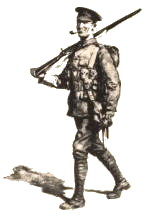
William James RAMSDALE's trade before enlistment is described on the Certificate as "Printer (Letterpress)" being also confirmed in the "Certificate of Transfer to Reserve Z on Demobilization" (Army Form Z 21) which describes his Medical Category as "B11".
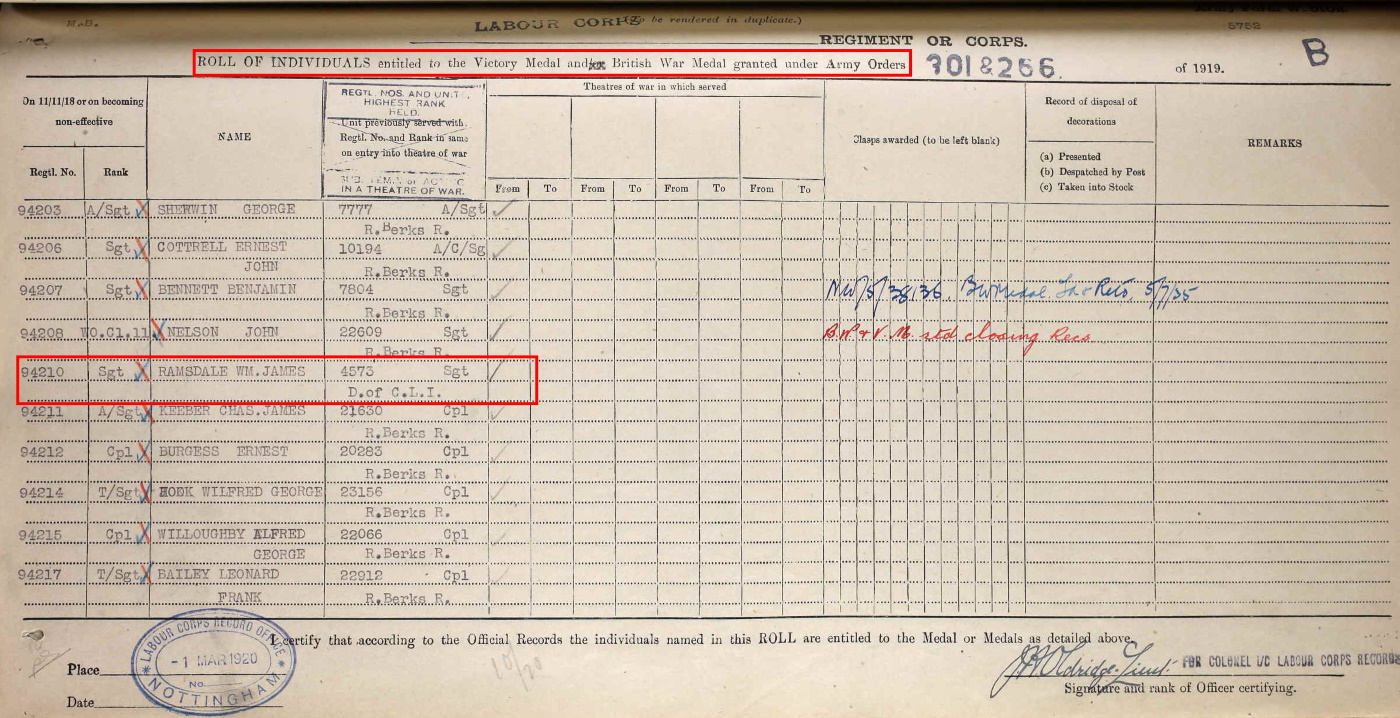
William James RAMSDALE enlisted (regimental numbers 4573 & 94210) in the Sixth [Service] Battalion of the Duke of Cornwall's Light Infantry (the Devonshire Regiment) on 29th August 1914 and served in that regiment until Friday, 19th May 1916 when he was transferred to the 10th (Light) Royal Berkshire Regiment. DCLI regimental numbers in the range 11000 to 11999 were issued to those recruits who joined the DCLI before September, 1914. A small number went to the 1st Battalion, and the majority of the rest were shared between the 6th and 7th Battalions, the latter being formed on 22nd September.
On 13th May 1917 William James RAMSDALE was transferred to the 158th Labour Corps (regimental number 94210). Source - "Certificate of Employment During the War" (Army Form Z 18) completed by Lieutenant L V Wilson whose "Special Remarks" read as follows:
"During the whole time this NCO has been with this Company he has given the entire satisfaction as a Sergeant."
The 6th (Service) Battalion was formed at Bodmin in August 1914 as part of K1 and came under the command of 43rd Brigade in the 14th (Light) Division. Moved to Aldershot but by November 1914 was at Witley. Moved back to Aldershot in February 1915. Landed at Boulogne on Saturday, 22nd May 1915. On Wednesday, 20th February 1918 it was disbanded in France.
The DCLI found it tough going when trying to recruit local men for the first of the regiment's new service battalions (the 6th Battalion) and was compelled to rely on large numbers of 'foreign' recruits from an early stage. This could explain the reason for the recruitment of William James RAMSDALE (Birmingham born and bred) by the DCLI.
The 10th (Labour) Battalion, Royal Berkshire Regiment, was formed in the latter part of 1915 under Colonel J. H. Balfour as a Labour Battalion. It was based at Cambridge Barracks in Portsmouth and was formed of men who were deemed not suitable for front line duties. After October 1915 large numbers of conscripts began arriving and those classified as "for labour service" were initially allocated to Headquarters Works Companies but these were then formed into the 10th (Labour) Battalion. They were brought back briefly to Reading over the Christmas of 1915. On Sunday, 7th May 1916 they were mobilised and on Friday, 19th May 1916 William was transferred to the 10th (Labour) Battalion, Royal Berkshire Regiment. On the night of Sunday 18th/19th June 1916 the 10th (Labour) Battalion embarked for France after having been delayed by influenza. They went to no 3 Labour camp at Rouen where they were employed on loading and unloading supplies from trains. On Saturday, 12th May 1917 the 10th (Labour) Battalion was transferred to the Labour Corps as the 158th and 159th Labour Companies of the newly formed Labour Corps and virtually severed all links with the rest of the Regiment.
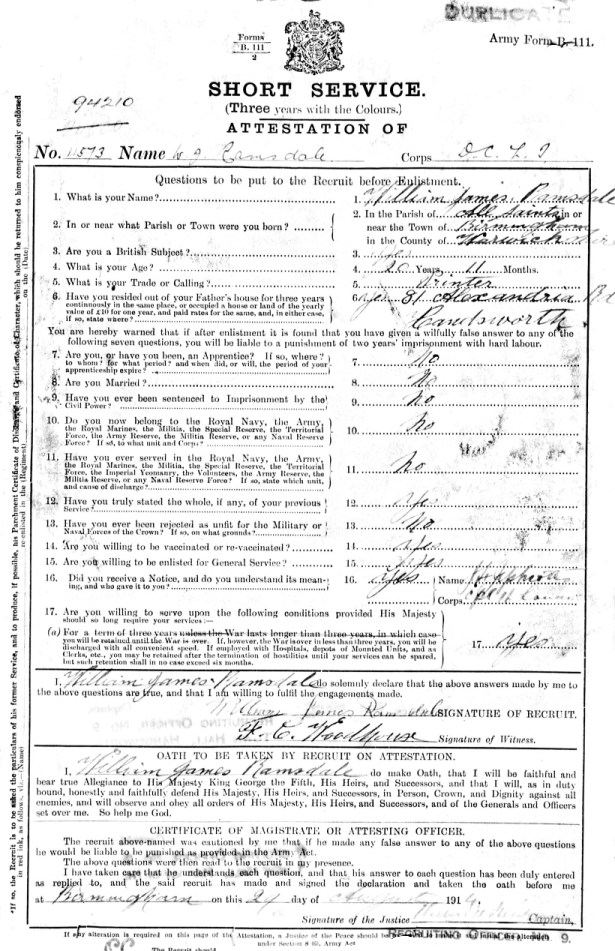
Short Service Attestation of W. J. RAMSDALE
| Short Service (Three years with the Colours) Army Form B 111 | ||
| 4573, 94210 | Attestation of W J RAMSDALE | D.C.L.I. |
| 1 | What is your name ? | William James Ramsdale |
| 2 | In or near what parish or town were you born ? | In the parish of All Saints near the town of Birmingham in the county of Warwickshire |
| 3 | Are you a British subject ? | Yes |
| 4 | What is your age ? | 20 years 11 months |
| 5 | What is your trade or calling ? | Printer |
| 6 | Have you ever resided out of your father's house for three years continuously in the same place, or occupied a house or land of the yearly value of £10 for one year, and paid rates for the same, and, in either case, if so, state where | Yes, 81 Alexandria Road, Handsworth |
| 7 | Are you, or have you been, an apprentice ? If so where ? to whom ? for what period ? and when did, or will, the period of your apprenticeship expire ? | No * |
| 8 | Are you married ? | No |
| 9 | Have you ever been sentenced to imprisonment by the civil power ? | No |
| 10 | Do you now belong to the Royal Navy, the Army, the Royal Marines, the Militia, the Special Reserve, the Territorial Force, the Imperial yeomanry, the Volunteers, the Army Reserve, the Militia Reserve, or any Naval Reserve Force ? If so, state what unit and Corps ? | No |
| 11 | Have you ever served in the Royal Navy, the Army, the Royal Marines, the Militia, the Special Reserve, the Territorial Force, the Imperial yeomanry, the Volunteers, the Army Reserve, the Militia Reserve, or any Naval Reserve Force ? If so, state which unit and cause of discharge | No |
| 12 | Have you truly stated the whole, if any, of your previous service ? | Yes |
| 13 | Have you ever been rejected as unfit for the Military or Naval Forces of the Crown ? If so, on what grounds ? | No |
| 14 | Are you willing to be vaccinated or re-vaccinated ? | Yes |
| 15 | Are you willing to be enlisted for General Service ? | Yes |
| 16 | Did you receive a Notice, and do you understand its meaning, and who gave it to you ? | Yes |
| 17 | Are you willing to serve upon the following conditions provided His Majesty should so long require your service ? | Yes |
| (a) | For a term of three years, unless the War lasts longer than three years, in which case you will be retained until the War is over. If, however, the War is over in less than three years, you will be discharged with all convenient speed. If employed with Hospitals, depots of Mounted Units, and as clerks etc you may be retained after the termination of hostilities until your services can be spared, but such retention shall in no case exceed six months. | |
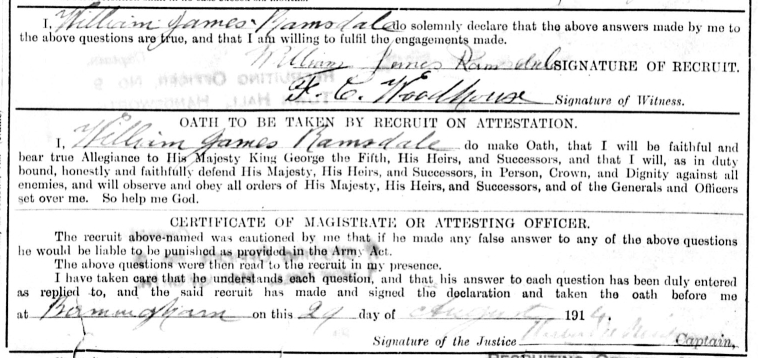 |
||
* This was not strictly true. William James RAMSDALE had been indentured as a Letterpress Machineman to J G Hammond and Company Limited since 24th October 1910 and, when told of his enlistment, his employers cancelled the "remaining portion of his indenture" on 31st August 1914.
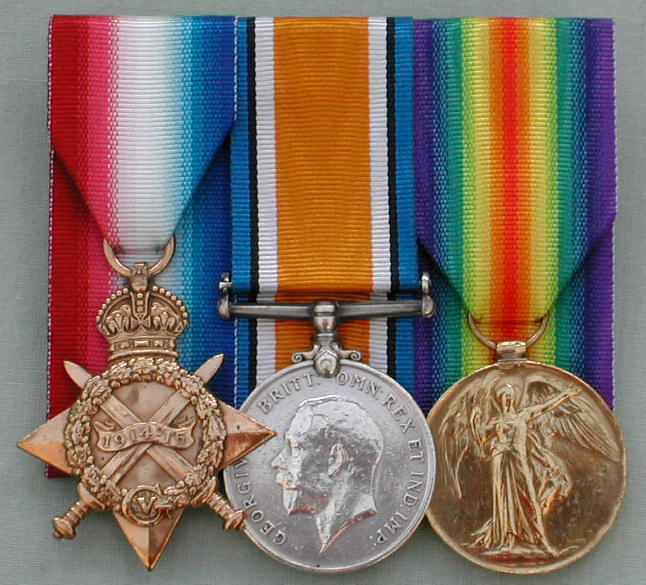
William James RAMSDALE arrived in France on Friday, 21st May 1915 and was eventually assigned to Class Z Reserve on Wednesday, 26th March 1919 (most fit soldiers were transferred to this category) - Serial # ZR 47/R/99. He was wounded twice and decorated three times.
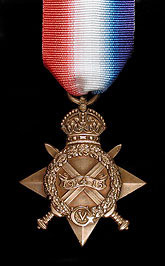 |
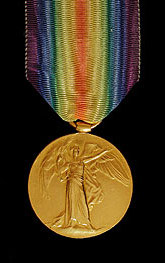 |
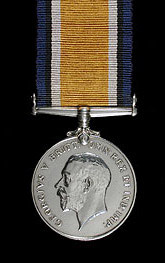 |
| 1914-15 Star Private 15ST Roll LC/32C Page R/41/1 |
Victory Medal Sergeant BWM.VIC. Roll LC/101 B57 Page 5762 |
British War Medal Sergeant BWM.VIC. Roll LC/101 B57 Page 5762 |
The 1914-1915 Star was sanctioned in December 1918, and was nearly identical in design to the 1914 Star. It was awarded to all personnel who served in any theatre of war against the enemy, even those who served at sea, between 5th August 1914 and 31st December 1915. Those already in possession of the 1914 Star were not eligible for the 1914-1915 Star. This medal is always issued with the British War Medal and the Victory Medal.
The Inter-Allied Victory Medal was agreed to by all the allies in March 1919. All medals were to be almost identical to obviate the need to exchange allied medals and each was patterned after a French medal of 1870. The medal was authorised in Britain on 1st September 1919. The medal was awarded to all ranks of the fighting forces, to civilians under contract and others employed in military hospitals who actually served in the establishment of a unit in a theatre of war between 5th August 1914 and 11th November 1918 (inclusive). It was also awarded to members of the British Naval mission to Russia 1919 - 1920 and for mine clearance in the North Sea between 11th November 1918 and 30th November 1919. This medal was never issued alone and was always issued with the British War Medal. A multiple-leaved emblem is worn on this medal when it was awarded to those "Mentioned-in-Despatches."
The British War Medal was authorised on 29th July 1919 and awarded to all ranks who rendered service to His Majesty's Forces between 5th August 1914 and 11th November 1918, or who had served in a theatre of war. Those who had enlisted in the O.M.F.C. in the United Kingdom and had not served in a theatre of war were not entitled to this medal. The requirements for RAF personnel were the same as for the army. Naval personnel were required to have 28 days of mobilised service or to have lost their lives before this period of service was complete.
WW1 medals were not awarded until after the end of the Great War and attributed to the particular regiments in which the decorated soldiers were then serving - in the case of William James RAMSDALE, The Duke of Cornwall's Light Infantry and The Royal Berkshire Regiment.
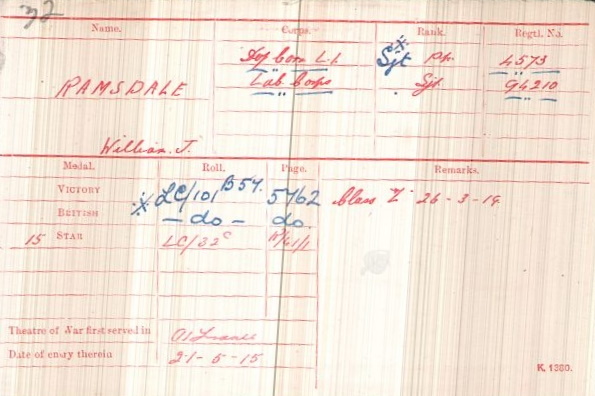
(above) William James RAMSDALE: Medal Card
Victory, British War and '1915 Star' medals
DCLI Private 4576, Labour Corps Sergeant 94210
Class Z Wednesday, 26th March 1919
Theatre of war: France, date entered France: Friday, 21st May 1915
(above) Sergeant William James RAMSDALE, Labour Corps, Regimental number 94210
Duke of Cornwall's Light Infantry, Regimental number 4573
Roll of Individuals entitled to the Victory and British War Medals
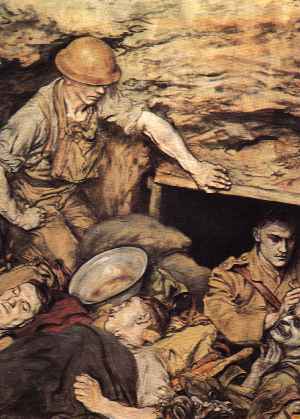
British Army Daily Rations: 1914
- 20 ounces fresh or frozen meat or 16 ounces preserved or salt meat
- 20 ounces bread or 16 ounces biscuit or flour
- 4 ounces bacon
- 3 ounces cheese
- 0.625 ounces tea
- 4 ounces jam
- 3 ounces sugar
- 0.5 ounce salt
- 0.03 ounce pepper
- 0.05 ounce mustard
- 8 ounces fresh or 2 ounces dried vegetables
- 0.1 gill lime juice if fresh vegetables not issued (at discretion of commanding general)
- 0.5 gill rum (at discretion of commanding general)
- not exceeding 2 ounces tobacco per week
The following substitutions were permitted if necessary:
- 4 ounces oatmeal or rice instead of 4 ounces bread or biscuit
- 0.03 ounce chocolate instead of 0.17 ounce tea
- 1 pint porter instead of 1 ration spirit
- 4 ounces dried fruit instead of 4 ounces jam
- 4 ounces butter, lard or margarine, or 0.5 gill oil, instead of 4 ounces bacon
Iron Ration (carried in the field)
- 16 ounces preserved meat
- 12 ounces biscuit
- 0.625 ounce tea
- 2 ounces sugar
- 0.5 ounce salt
- 3 ounces cheese
- 1 ounce meat extract (2 cubes)
Events after World War I
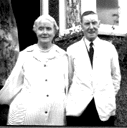
William James RAMSDALE married Elsie Mason in St Silas Parish Church, Lozells, Birmingham on Sunday, 31st July 1921 in the presence of George A (her only brother) and Nellie Mason (her younger twin sister). Elsie Mason was born at 10am on Sunday, 27th September 1896 at Back 116, Heaton Street, Birmingham. At the time of their marriage William resided at 81 Alexander Road, Handsworth, Birmingham.
On Saturday, 4th February 1922 the Ministry of Pensions notified William, then residing at 81 Alexander Road, Handsworth, Birmingham, as follows:
- Disability: GSW (gun shot wound) left thigh and knee
- Decision on Entitlement: Nil Disability due to Service
The accompanying letter from the Awards Section of the Ministry of Pensions reads as follows:
"I am directed by the Minister of Pensions to inform you that having considered the report furnished in connection with your recent medical examination, he has decided to award you a Final Weekly Allowance of 8/6 (eight shillings and sixpence) for 69 weeks plus terminal gratuity of £10:0:0 (Ten Pounds) payable only at end of period."
(above) Sergeant William James RAMSDALE, Labour Corps, Regimental number 94210
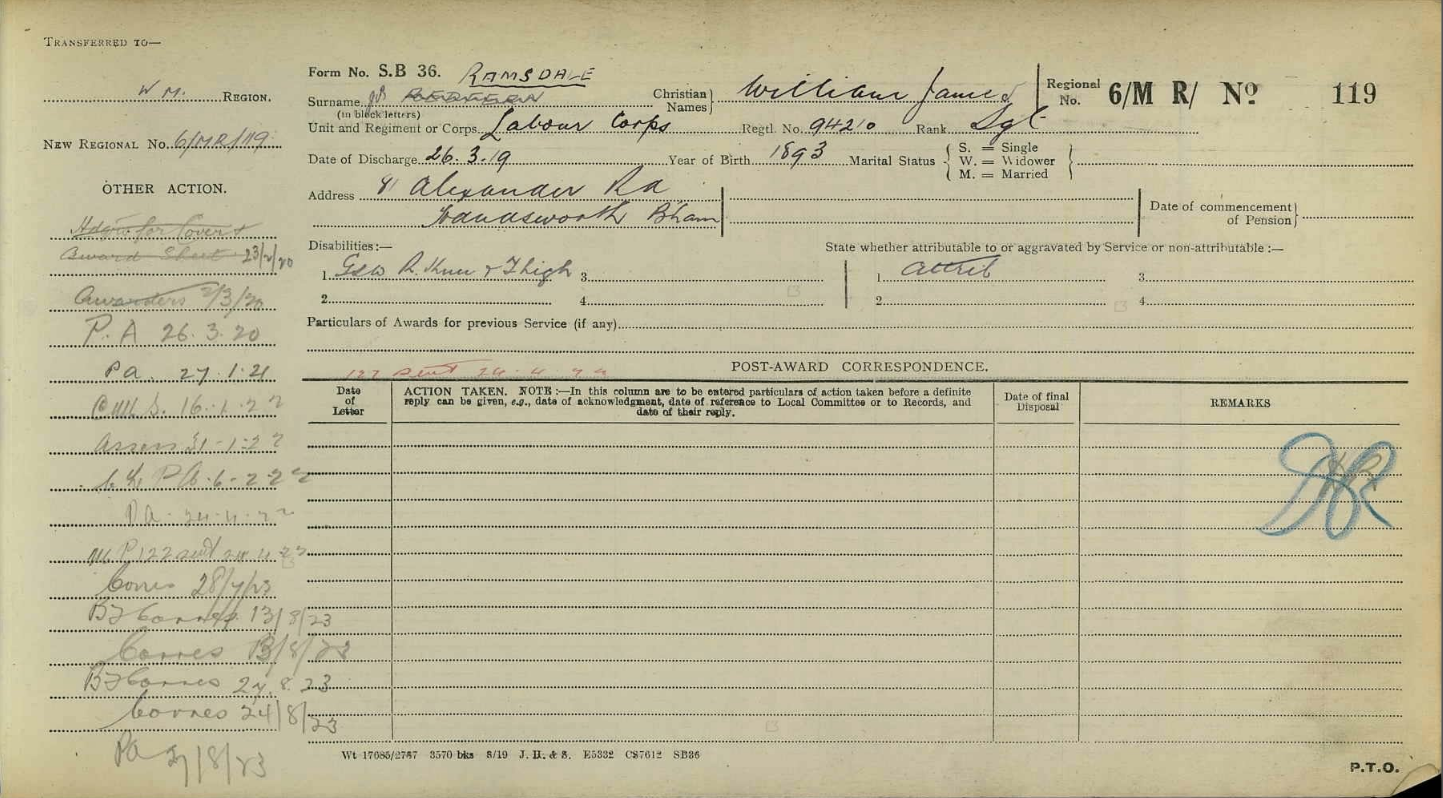
UK WW1 Pension Record Ledgers and Index Cards 1914-1923
| Image Info | |
| Full Name: | RAMSDALE, William James |
| Birth Date: | 1893 |
| Discharge Date: | Wednesday, 26th Mar 1919 |
| Address | 81 Alexander Road, Handsworth, Birmingham |
| Service Number: | 94210 |
| Rank: | Sgt |
| Regiment: | Labour Corps |
| Disabilities | GSW Right Knee and Thigh |
| (attribution) | (Disability) attributable to Service |
| Reference Number: | 430/06MR |
| Document Number: | 6/MR/119 |
The Character Certificate (Army Form B 2067) dated 17th August 1923 states that WJR's "character during his service with the Colours has been 'Exemplary'" and that William had been transferred to the Reserve on 26th March 1919 "… after having served with the Colours for four years two hundred and nine days."
From December 1924 to 1928 William James RAMSDALE and Elsie lived at 43 Haseley Road, Handsworth. They had two children:
- Mabel Elsie RAMSDALE, born on Saturday, 6th December 1924 and
- Robert William RAMSDALE, born on Monday 3rd December 1928.
William James RAMSDALE's occupation in 1928 was "Printer Journeyman".
On Saturday, 9th November 1940 F. J. Palmer, director of J. G. Hammond & Company Limited wrote the following reference:
"Mr W. J. Ramsdale has been employed by this Company for nearly 30 years as a machine minder and we have always found him during the whole of this period a most willing, honest, sober and trustworthy servant. In the ordinary way we should have been pleased to have employed him for many more years but unfortunately enemy action has made this impossible. We have no hesitation in saying in our opinion he will prove as valuable servant to you as he has done to us."
26 AUGUST, 1941 (4975)
J. G. HAMMOND & CO. Ltd.
NOTICE is hereby given pursuant to
section 238 of the Companies Act 1929
that a Meeting of the creditors of the
above named Company will be held
at 44-47, St. Martin's Lane,
London, W.C.2, on Wednesday
the 17th day of September 1941
at 3.30 o'clock in the afternoon
for the purposes provided in
sections 239 and 240 of the said Act.
(088) E. J. HARRISON, Secretary.
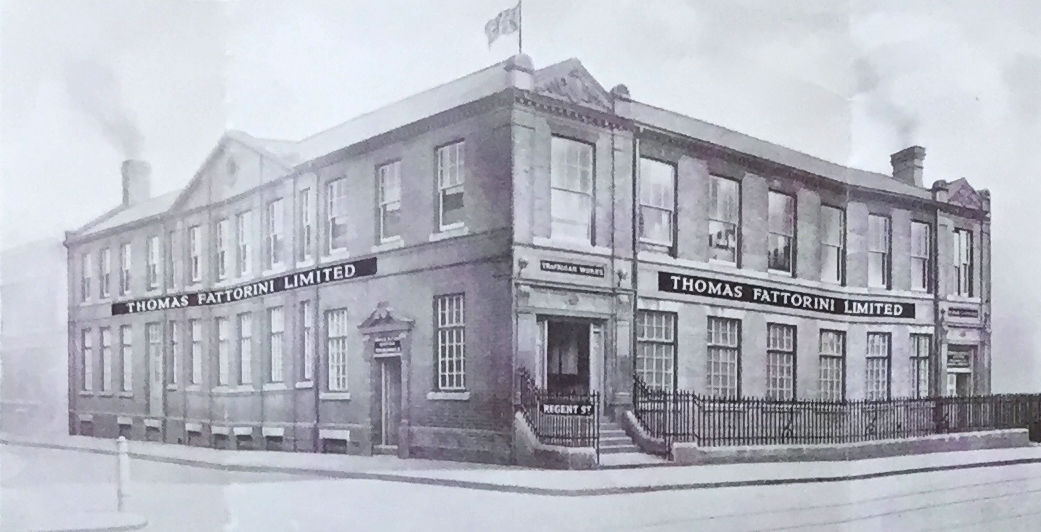
During the second world war William James RAMSDALE was employed by Thomas Fattorini Limited as a night watchman at its Regent Street Works in Birmingham. The company presented him with a watch commemorating his bravery in saving the Works from fire following a direct hit by a German incendiary bomb. The damage to the railings near the corner of Frederick and Regent Streets was caused by shrapnel during the raid and has been deliberately left unrepaired by the Fattorini family.
Their last home was 46 Sheppey Drive, Chelmsley Wood, West Midlands.
Elsie died in the East Birmingham Hospital, Bordsley Green, Birmingham on 15th May 1975. Her cause of death was:
- bronchopneumonia due to recumbency following fractured left femur
- fall at home
- accidental death
"Certificate received from G. Billington, Coroner for Birmingham District. Inquest held 19th May 1975."
Outward clinical symptoms of bronchopneumonia can include fever, coughing, chest pain, chest congestion, chills, difficulty with breathing and blood-streaked mucus that is coughed up. Upon diagnosis, most people will be treated at home with antibiotics. If the patient has a severe case of bronchopneumonia, he or she may be treated in the hospital where the illness can be more closely monitored. With appropriate treatment, most people recover fully within a couple of weeks. Bronchopneumonia is more common in elderly people who can die from bronchopneumonia if they do not get appropriate treatment.
William James RAMSDALE died in Birmingham on Friday 15th January 1982. His cause of death was also stated to be bronchopneumonia.